

 When you buy through affiliate links in our content, we may earn a commission at no extra cost to you. Learn
Onchain experts say over $228 billion worth of Bitcoin — almost 18% of the global BTC supply — has sat dormant for the past decade.
The CryptoQuant analyst Darkfrost took to X earlier this week to opine that the crypto community must now consider these coins “lost” and currently irretrievable. Several experts, however, say there’s no need to press the panic button yet. There may be ways to get the missing currency back into circulation.
“Over the past 30 days, more than 14,000 Bitcoin [worth over $1 billion] have been added to this dormant share of the supply,” Darkfrost wrote.
Around 96% of Bitcoin’s 21 million coins are already in circulation. As such, the idea of writing off so much BTC is appalling to some, even in a community originally built on the idea that scarcity and deflation are desirable.
Missing Bitcoin: Synthetic Float to the Rescue
It has been a slow and depressing year for Bitcoin investors. The bear market continues to bite, and analysts say prices are yet to reach their bottom.
Trading volume and liquidity have fallen to their lowest levels since 2019, the crypto exchange Bitfinex said this week.
Some say that the $228 billion hole in the Bitcoin supply is one of the reasons trading volumes are so low.
The Binance founder Changpeng Zhao recently said up to 20% of the Bitcoin already on the network may be gone. He said the coins are likely “lost, stuck, or unrecoverable.”
“It’s a deflationary asset,” he said.
However, other experts say that the 21 million Bitcoin hard cap only matters “in theory.”
“In reality, the synthetic float of Bitcoin now matters more,” Dominic Basulto, a contributing crypto analyst at the media outlet The Motley Fool, told Techopedia. “Financial derivatives such as futures and options are making it possible for market participants to trade billions of dollars in Bitcoin, without actually owning the physical BTC.”
That means a potential 18% reduction in circulating supply might not have the same price impact as might have been the case a few years ago, Basulto said.
“If anything, it will only lead to more innovation in the so-called ‘paper Bitcoin’ market,” he explained. “We’re already seeing this with the launch of US regulator-approved Bitcoin perpetual futures.”
Some analysts have previously argued that Bitcoin innovators have “invited Wall Street in” to the BTC party.
This has ended the scarcity problem, they argue. A plethora of Bitcoin futures, perpetuals, options, and exchange-traded funds have appeared on the market. And these have turned BTC into a commodity that some say behaves much like gold.
A $228 Billion Conundrum
While some have heralded the arrival of the synthetic layer, others are not so sure.
Per the crypto wallet provider Wirex’s estimations, Bitcoin ETFs, public companies, private companies, and countries have already gobbled up 17% of Bitcoin’s total maximum supply.
ETFs alone hold close to BTC 1.5 million, with public companies holding onto about BTC 1.09 million, the firm said.
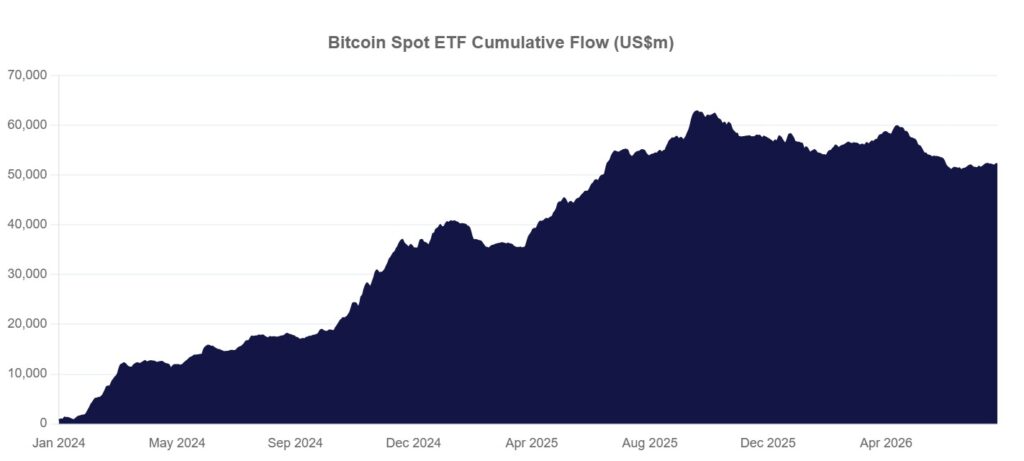
“When Bitcoin moves into ETFs, corporate treasuries, and government reserves, it can reduce the amount of BTC available on the open market,” the firm wrote. “That can affect Bitcoin liquidity, long-term Bitcoin price action, and the idea of a potential Bitcoin supply squeeze during periods of rising demand.”
However, the issue remains. The $228 billion hole is still bigger than the synthetic layer’s entire market value.
What has happened to all these coins? Nearly a third of the BTC are still sitting in Bitcoin founder Satoshi Nakamoto’s wallets, Michael Terpin, CEO of the blockchain firm Transform Venture, told Techopedia.
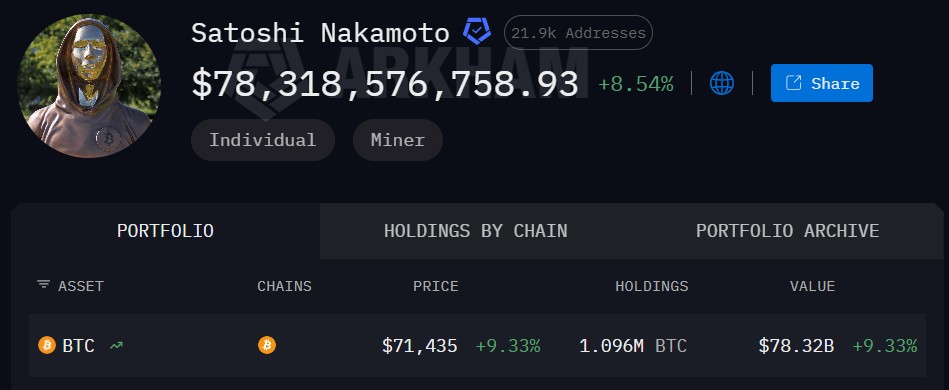
“Bitcoin that hasn’t moved in a decade is either intentional long-term, set-it-and-forget-it investors, or they are lost from misplaced keys or deaths with no succession instructions,” Terpin said.
Both scenarios are good for Bitcoin, he added, as they effectively remove around 4 million coins from circulation.
“Dormancy of addresses supports the case of Bitcoin’s scarcity,” a group of analysts at the decentralized finance firm Yield Basis told Techopedia. “But just because they haven’t moved in a long time, it doesn’t necessarily mean their supply has been permanently removed from circulation.”
Quantum Computing Could Help Recover Lost BTC
Some think that quantum computing, a novel form of computer technology, will one day develop enough power to crack the cryptographic keys that protect Bitcoin wallets.
Some Bitcoin advocates fear hackers will use this power to drain unprotected wallets. The silver lining, however, is that the holders of “lost” coins could one day use quantum computing to recover their passwords and their currency.
“Quantum computing could recover these [Bitcoin wallets’] lost keys,” Terpin said.
While this sounds like a good thing on paper, an influx of supply could potentially disrupt markets.
Terpin dismissed the quantum threat to markets, calling it “a one-time event that Bitcoin will recover from.”
Some experts think quantum computing will help blockchain analysts learn more about the “lost” Bitcoin.
“If Bitcoin completes a post-quantum migration, it will provide the market with a much better understanding of what percentage of the supply is actually inaccessible,” said the Yield Basis analysts.
Quantum computers will let developers move any BTC that “fail to migrate in time” back into circulation, they said.
“This can also be a positive for the market,” the analysts concluded. “The coins could then be sold to participants who could use BTC in more productive ways.”