

 When you buy through affiliate links in our content, we may earn a commission at no extra cost to you. Learn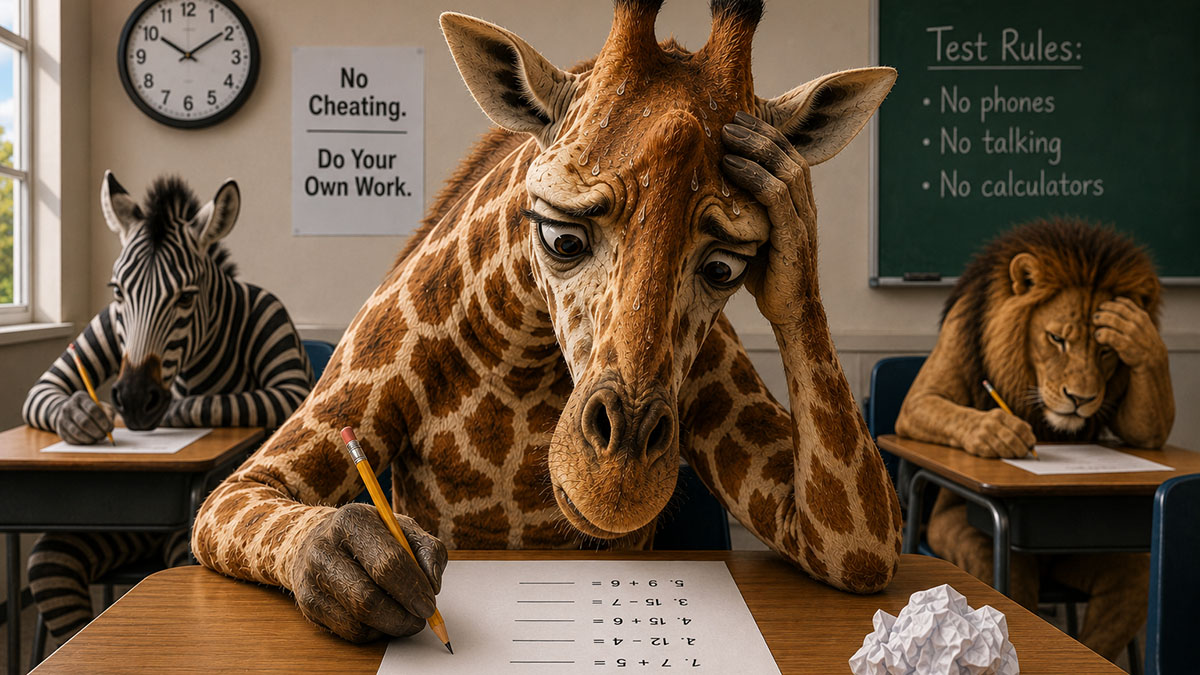
Human children typically learn basic addition before subtraction, and research on animals — most recently giraffes — confirms that mentally removing objects from a set is a more difficult cognitive challenge than combining them.
Giraffes, it turns out, can generally keep track of which set of objects is larger if they see items being added, although some giraffes are better at this than others. On the other hand, researchers found that all of the giraffes in their study group failed at tasks as soon as any items were being removed.
The study in question was performed by a team of five researchers from the Institute of Neurosciences at the University of Barcelona and published in Scientific Reports by Springer Nature.
As with most studies in animal psychology, food motivation was key to testing the giraffes. The researchers used carrot cubes — a favorite food — as the motivation, which they placed into closable containers so the giraffes could be shown the contents or not.
Once shown how many carrot cubes a box contained, the giraffes would reliably pick the box with more, regardless of whether it was left open or subsequently closed.
The giraffes continued to perform well overall if they saw the researchers adding cubes to a box after it was closed. For instance, if they saw two cubes in the left box before it was closed and another two added afterward, they would usually pick that over the right box if they’d seen three cubes there. However, they would usually choose the right box if they’d seen five.
When carrot cubes were removed from a box, however, the results were inconclusive. Although the giraffes still chose the box with more cubes more than half the time, they made enough mistakes that the researchers could not rule out the possibility that they were just getting lucky.
Intellectual Laziness Among Giraffes
The researchers had to be careful to make sure the giraffes weren’t taking any shortcuts. For instance, if the initial and added numbers of items were totally random, just choosing the largest single number of cubes they’d seen would be a better-than-chance strategy.
All four giraffes showed that they would get the right answer even in cases when that strategy would fail. For instance, they would fairly reliably choose 2+2 over 3.
However, there were indications that half the giraffes were relying on a different shortcut, tending to pick the box to which carrots were being added, regardless of the quantities involved. So, if the problem was 1+2 vs. 4, the giraffes were split. The smarter two giraffes would reliably get to snack on four cubes, but the ones that were taking the shortcut would be fooled.
Intraspecies and Interspecies Differences
It’s interesting that even within this small group of four individuals, there were distinct differences in cognitive capacity. Just as some humans are better at math than others, the species that show ability with these sorts of simple tasks also have variation between individuals.
Of course, the differences from species to species are much larger.
If we’re being very technical, the giraffes weren’t being tested for their ability to perform addition and subtraction. Math, per se, involves symbolic manipulation. The researchers instead describe these tasks as combination and dissociation.
Amazingly, some non-human species can also grasp numbers in the abstract, linking symbols to quantities the way we learn our numbers. But that’s not what the giraffes were being tested for.
The animals that are capable of understanding some level of abstraction, like certain apes and birds, also tend to be the ones that can handle subtraction. Crows, remarkably, can even wrap their heads around the idea of zero, something that usually alludes human children until they’re three or four.
This sort of research into the extent to which various animals are capable of math and other forms of reasoning is important as it sheds light into the evolutionary origins of intelligence and, ultimately, what makes us human.
Also in Science News
Debugging AI is Increasingly Like Psychology
Large language models keep getting more powerful, but their “black box” nature makes it difficult to predict when they’ll go awry, and why. Early models approached multi-step problems by generating intermediate output and, essentially, re-prompting themselves with their own words. More advanced models, however, use “continuous latent representations,” meaning that they iteratively crunch away on a mathematical object and only spit out human-readable text at the end.
That abstraction is more efficient, but it’s opaque. Telling what the machine is thinking is almost as hard as reading a person’s mind. It’s perhaps predictable, then, that we’ll see some convergence between the fields of psychology and computer science. Identifying error sources in AI requires understanding something about these latent thought processes — what’s happening with the data in between the input and output.
Psychoanalyzing the machines will require a new lexicon. Two Canadian researchers have proposed a set of four measurable quantities that effective machine thought should possess, as a starting point for error analysis:
- Causality: The thought should reliably produce the same output as its equivalent verbal representation in traditional train-of-thought textual reasoning.
- Minimality: The thought state shouldn’t include incidental information that won’t factor into output.
- Separability: It should be possible to mathematically differentiate qualitatively different thoughts.
- Stability: Two outputs with similar meaning but different phrasing shouldn’t come from mathematically different thoughts.
There will surely be competing proposals, but one way or another, the field of AI will eventually need a robust vocabulary to discuss these thoughts in the abstract and categorize the ways they can go wrong.
Unexplained Retraction of Planck Papers Alarms Physicists
Two papers by the long-deceased but extremely influential physicist Max Planck disappeared at some point from the online repository of German scientific journal Naturwissenschaften. No one knows exactly when, but it could have been shortly after they were digitized over 20 years ago.
The publisher hasn’t explained what happened and killed an article by its editor-in-chief, Suzanne Scarlata, attempting to address the issue. She had told Science that she was unaware of the retractions and described the situation as “crazy.”
Naturwissenschaften’s site only says that the articles were removed for “copyright violations.” The working theory in the physics community is that one paper had been published in two separate journals, while the other happened to share the same title as a separate paper critiquing Planck’s work on the philosophy of science.
Dinosaurs in Antarctica?
The first dinosaur fossil discovered in Antarctica has been identified as a vertebra from a titatonsaurian sauropod. That’s not to say that it is a recent discovery or the only dinosaur fossil yet discovered on the continent. This particular find was uncovered in 1985 and there have been a scattering of similar discoveries since. It simply hadn’t been formally identified and classified until now.
It may be hard to imagine dinosaurs living in Antarctica, but the world was a much hotter place 100 million years ago, and even Antarctica was a swampy, temperate place. However, little is known about the dinosaurs that inhabited it because the fossil record is buried under several kilometers of ice.
Fortunately for paleontologists (and unfortunately for everyone else), global warming is reducing the Antarctic ice sheet, presenting new opportunities to explore this niche of natural history.