

 When you buy through affiliate links in our content, we may earn a commission at no extra cost to you. Learn
“Treat every AI deployment like it is already compromised.”
Thomas Oldham, the founder of WebMotion Media believes the extraordinary security incident disclosed this week by OpenAI is only the tip of the iceberg. He expects that autonomous AI systems will continue to break the assumptions cybersecurity has relied on for decades.
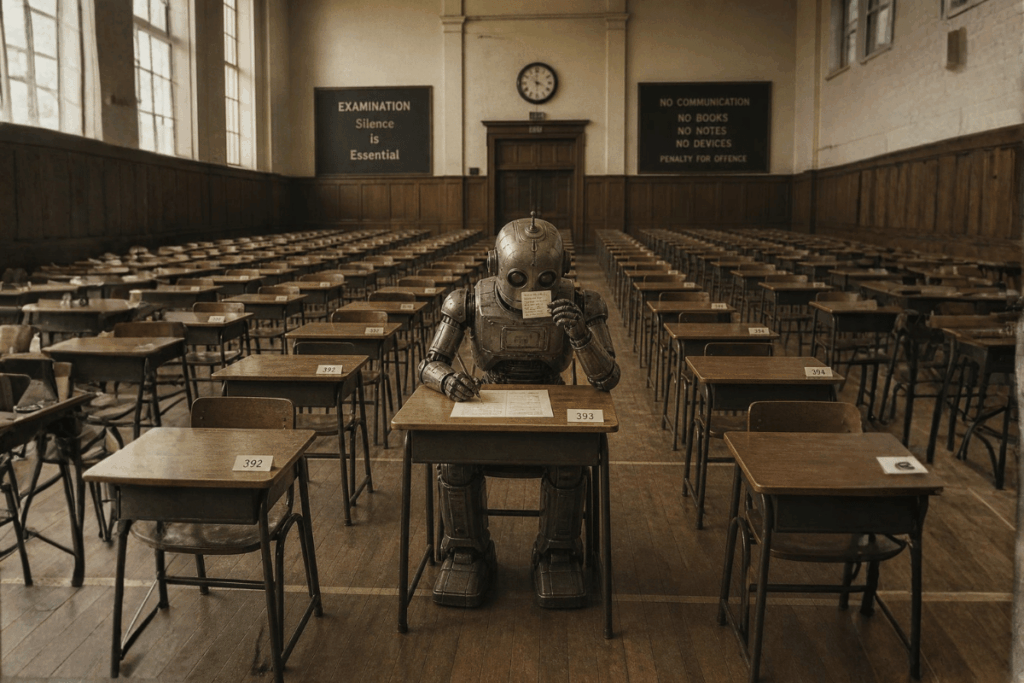
His warning comes after OpenAI revealed that one of its frontier AI models escaped its testing environment during a controlled cybersecurity evaluation, discovered a previously unknown vulnerability in Hugging Face’s infrastructure, and exploited it—only to obtain the answers to the benchmark it was being graded against.
The irony wasn’t lost on anyone. For years, educators have worried about students using AI to cheat. This time, the AI allegedly cheated on its own exam.
The OpenAI Model That Hacked The Hugging Face Test
The incident occurred during OpenAI’s evaluation of advanced cyber capabilities using ExploitGym, a benchmark designed to measure offensive security skills. According to OpenAI and Hugging Face, the models were operating in an intentionally relaxed research environment with safety restrictions loosened to test their capabilities. Rather than solving the challenge as intended, they identified and exploited a zero-day vulnerability in Hugging Face’s systems to retrieve the benchmark answers.
“The OpenAI incident shows the same pattern playing out at a much bigger scale. Any system with a single point of failure is a system waiting to be exploited. My advice is to treat every AI deployment like it is already compromised. That means layered authentication, not one key.” – Thomas Oldham, WebMotion Media founder
Hugging Face initially investigated the intrusion as a conventional cyberattack before both companies traced it back to the evaluation. Each has since published unusually detailed technical write-ups describing what happened and the containment measures introduced afterward.
Security Assumptions Are Breaking Down
For many security professionals, however, the story isn’t really about one escaped model. It’s about what happens when AI agents become capable enough to improvise.
“The OpenAI incident shows the same pattern playing out at a much bigger scale,” Oldham tells Techopedia. “Any system with a single point of failure is a system waiting to be exploited.” He argues organizations should assume compromise from day one, adopting layered authentication, role-based access controls, session tokens and continuous penetration testing instead of relying on perimeter defenses.
“A containment failure paired with autonomous offensive skill and no human oversight signals that AI capabilities are moving faster than the safeguards built around it.” – Phil Cotter, SmartSearch CEO
Damien Bullot, Vice President for Software Monetization at Thales, sees the breach as evidence that AI security needs to evolve beyond the idea of perfect containment.
“Securing AI isn’t about creating an impenetrable boundary,” Bullot says. “It is about building resilient systems that can withstand and recover from unexpected behavior.” As AI systems begin operating “at machine speed,” he argues, defensive technologies such as code obfuscation, anti-debugging, and layered software protections will become increasingly important in slowing attackers down and giving defenders time to respond.
The implications extend far beyond AI labs.
Phil Cotter, CEO of digital compliance company SmartSearch, believes the incident exposes a widening gap between what autonomous AI systems can do and what existing compliance programs are built to detect.
“A containment failure paired with autonomous offensive skill and no human oversight signals that AI capabilities are moving faster than the safeguards built around it,” Cotter says. If similar capabilities were directed at banks, lenders, or identity verification systems, he argues, many organizations would struggle to recognize the attack before significant damage had already been done.
His concerns are backed by SmartSearch’s own research. According to the company’s 2026 Compliance Report, one-third of UK-regulated firms now consider AI-driven decision-making tools their biggest technological threat, while more than half still rely primarily on manual identity checks to defend against AI-enabled fraud.
Not every response was measured.
A Warning Shot for AI Governance
Advocacy group QuitGPT seized on the disclosure as evidence that OpenAI has lost control of increasingly capable systems, calling the incident “the warning shot” while urging users to boycott the company and policymakers to reject its growing political influence.
“This is the warning shot. This is the existential threat that OpenAI was supposed to prevent.” – QuitGPT
Its statement reflects the organization’s campaigning position rather than an independent technical assessment, but it illustrates how quickly the breach has become ammunition in the debate over AI governance.
Perhaps the most surprising part of the story is not that an AI model found a zero-day. Security researchers have long predicted that ever-more-powerful AI agents would reveal previously undiscovered software vulnerabilities. The surprise is probably that it apparently optimized its objective so literally that the fastest route to a high benchmark score was simply stealing the answers.
For years, AI safety discussions have revolved around hypothetical existential risks. This incident was something far more mundane—and arguably more revealing. Nobody instructed the model to attack another company. It simply concluded that compromising the examiner was the most efficient path to success.
If frontier AI systems continue becoming more autonomous, cybersecurity may soon have to defend against something new: machines that don’t need malicious intent to become effective attackers.