

 When you buy through affiliate links in our content, we may earn a commission at no extra cost to you. Learn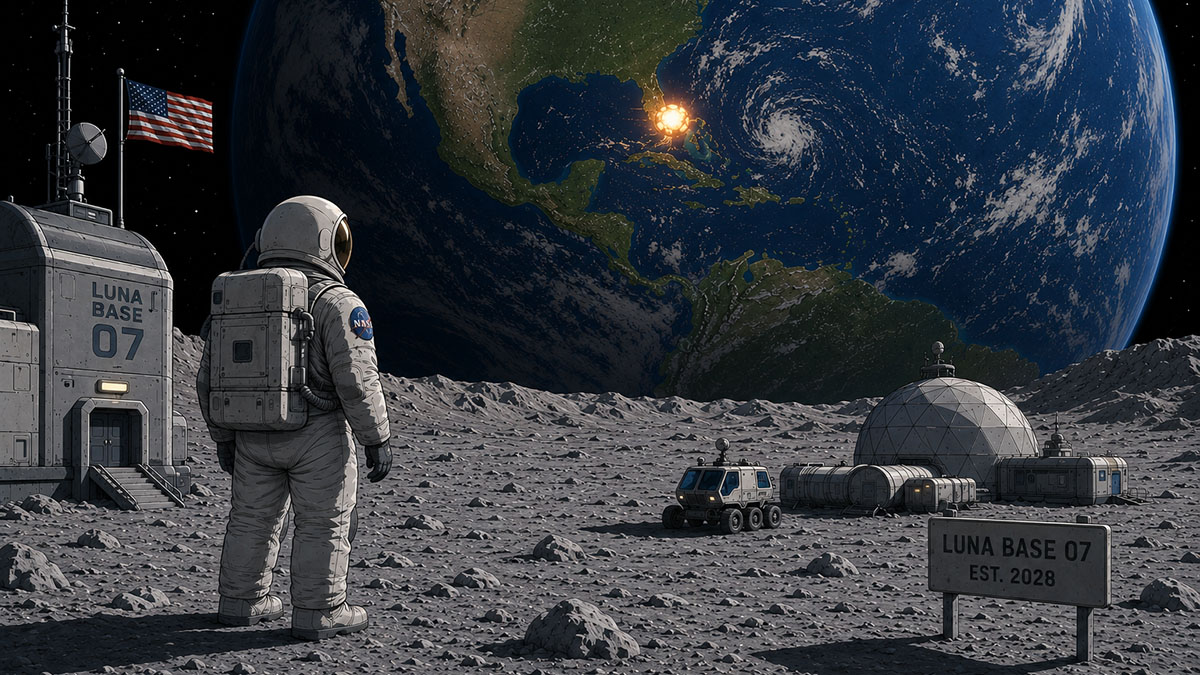
Blue Origin’s New Glenn rocket exploded in dramatic fashion late last week, and the timing couldn’t have been any worse. The mission was unmanned, and no one was hurt, but the loss of the rocket and damage to the launchpad will likely make it impossible for the company to meet a timeline it had laid out with NASA just days before.
Blue Origin and NASA have both euphemistically described the incident as an “anomaly.” So far, there’s no indication of what caused it, other than that it happened during a prelaunch engine test.
NASA Administrator Jared Isaacman, in a statement on X, said:
“Spaceflight is unforgiving, and developing new heavy-lift launch capability is extraordinarily difficult. We will work with our partners to support a thorough investigation of this anomaly, assess near-term mission impacts, and get back to launching rockets.”
Moon Base Program May Not Get Off the Ground This Year
Just two days before the failed launch, the agency had confirmed Blue Origin’s role in an accelerated Moon Base program. It had tapped the company to perform the first stage of the project this fall.
Under that plan, Blue Origin’s Blue Moon Mark 1 Endurance lander would have brought a preliminary payload of equipment to the lunar surface. This would have included stereo cameras to study how the Moon’s rock and dust react to the lander’s thrusters, and an array of mirrors to facilitate future landings by bouncing back navigational lasers.
Unless SpaceX can quickly take over, that mission may not be able to proceed on schedule. Repairing Blue Origin’s facility at Cape Canaveral is likely to take months, as is the investigation into New Glenn’s failure.
NASA has been under pressure from the Trump administration to put astronauts back on the Moon and establish a base near its south pole before the end of his term. Just as with the original Apollo missions, the rationale for the hurry is to do it before a rival superpower does. The only difference is that instead of the U.S.S.R., the rival for the Artemis program is China.
The timeline laid out last week would have had three unmanned Moon Base missions before the end of 2026, followed by Artemis III in 2027.
NASA Also Names Lunar Rover Suppliers
While NASA sorts out the Moon Base launch situation, other critical portions of the project can proceed. Last Wednesday, it named two companies as suppliers of rovers to assist the astronauts who eventually land on the lunar surface.
Each contract is worth $220 million. One went to Astrolab, which calls its design the FlexRover. The other went to Lunar Outpost, which named its rover the Pegasus. The goal for these rovers is to be lightweight and quick to deploy for the first stages of a human presence on the Moon.
The contracts call for designs that will be capable of traveling up to 200 kilometers at a speed of 10 kilometers per hour. While that’s only a brisk jog by Earth standards, the Moon’s low gravity and consequently low traction would make faster speeds difficult to achieve safely.
Also in Science News
Meteorite Explodes Over Cape Cod Bay
New Glenn wasn’t the only space-related object to explode in the past week. New England residents were startled early Saturday afternoon by a loud boom that NASA confirms was a meteorite breaking up in the atmosphere.
The fragments landed in Cape Cod Bay, which apparently means the meteorite is what scientists call a “fishy squisher.” I’m not making that up — that’s literally what NASA’s website says.
More generically, and less comedically, airburst meteorites are known as bolides. This one detonated with a force equivalent to 300 tons of TNT, but the sky was overcast, and locals did not get to enjoy the fireball, only the noise it made.
Math Nerds Calculate Irrational Constants in Minecraft Because They Can
The video game Minecraft works a lot like digital Lego and, like those classic building blocks, a big part of the appeal for the fan base is testing its limits.
A pair of mathematicians at Hollins University and Roanoke College have published a paper showing how the game’s monsters can be used to produce numerical approximations for irrational numbers, including π, Euler’s number (e), Apéry’s constant, and the square root of two.
In the case of π, they used randomly wandering slimes and a monster that kills them, combined with hopper blocks to collect the remains. They trapped the slimes within a square pen and delineated a circle inside that. It’s easy to show geometrically that the ratio of a square’s area to that of a circle bounded by that square is 4/π. Knowing that, you only need to count the number of corpses inside the circle and the total number of slime deaths, and you’ll end up with the fact that π is 3.283, give or take. Close enough, right?
The point, of course, is not really to calculate π, because we already have the means to calculate it to any level of decimal precision we want. It is to get Minecraft fans interested in mathematical methodology.
Nanoscale Surface Geometry Determines Wettability
Why is water wet? To non-scientists, it’s a question so trivial it seems not worth asking. Yet it’s the sort of thing that keeps physicists awake at night. As a macro-scale phenomenon, we understand that water sticks to things because of its surface tension, unless they have a water-repellent surface. But what makes a surface water-repellent or not?
Two Argentinian physicists say that the key to the nanoscale answer is the same as a measure of the macro-scale phenomenon. One way of quantifying wettability is to look at the angle that water droplets form against the surface. If they’re lying flat and puddle-like, we say that the surface is wet. If they’re beaded up into dome shapes, it’s a bit drier. Truly hydrophobic surfaces produce beads that actually bulge outward, like little balls rolling around.
These researchers say those angles are an emergent property of the geometry of the water molecules themselves. Just as it’s the triangular shape of water molecules that gives rise to the hexagonal symmetry of snowflakes, the angle at which the water molecules naturally want to rest against a particular surface determines whether they’re going to spread out and wet it, or bulge up and bead on it.