

 When you buy through affiliate links in our content, we may earn a commission at no extra cost to you. Learn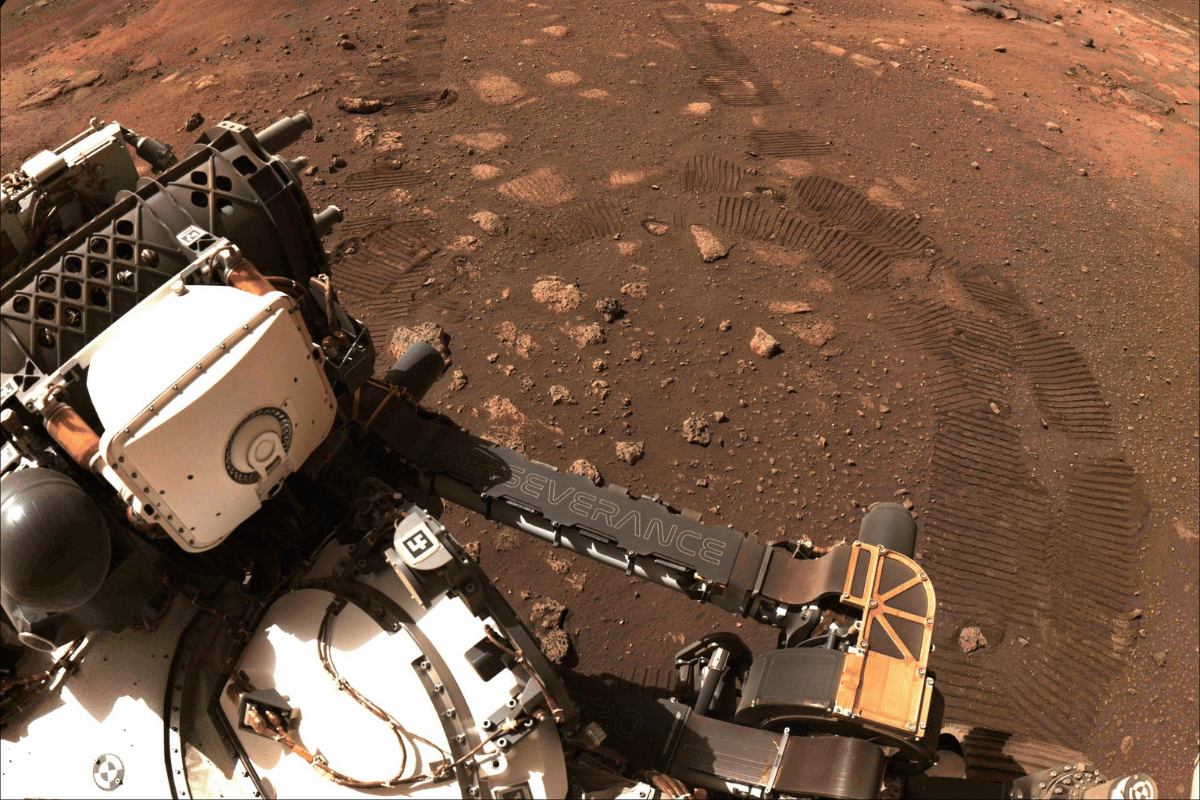
NASA has given a name and a new job to a rover that until now has served only as a stand-in. The agency intends to send PROMISE (Polar Rover for Observation, Mapping and In-Situ Exploration) to its planned lunar base. It’s effectively a twin of Perseverance, the rover that recently completed a marathon on Mars.
PROMISE began as an engineering model, a fully working double of Perseverance that the mission team used on Earth to rehearse maneuvers and troubleshoot problems before trying them on the real rover millions of miles away.
In its earlier life, the team called the rover OPTIMISM. The new name reflects the significant change in destination. It will no longer gather dust as a backup. Instead, engineers think they could repurpose it for a completely different world. They believe they can modify the rover to cope with the Moon, despite originally designing it for Mars.
A Proven Rover Paves the Way for NASA’s Lunar Future
NASA plans to send PROMISE to scout the lunar south pole, characterize the surface, and examine what lies beneath. The rover could also search for resources that a permanent outpost would need. NASA also recently revealed contracts with three aerospace firms for four lunar landers that the companies plan to launch by the end of 2028. This forms part of a wider mission to send 17 landers to the Moon over the next few years.
Everything supports the Moon Base program and the Artemis mission, which aim to return astronauts to the lunar surface and establish a base by 2030 that can sustain a long-term human presence.
NASA’s Perseverance rover has reached a noteworthy milestone by becoming just the second machine in history to drive a full marathon on another world. The six-wheeled explorer passed the 26.2-mile mark on June 14, taking about five years and four months to achieve the feat.
Opportunity became the first machine to reach this milestone in 2015. It roamed across Mars for more than a decade and took 11 years and two months to cover a marathon distance. Perseverance completed the feat in less than half that time, which makes the achievement impressive. Curiosity continues to trundle across Gale Crater after landing in 2012 and has covered around 23 miles.
NASA’s Mars Reconnaissance Orbiter photographed Perseverance from above on June 13, the day before the rover reached marathon distance. The High-Resolution Imaging Science Experiment (HiRISE) camera captured the image, which shows the rover as a tiny green speck against the rust-colored landscape.
However, NASA did not send Perseverance to Mars simply to cover distance. The rover touched down in Jezero Crater in February 2021. Rivers once fed the roughly 28-mile-wide basin when it held a lake. Scientists consider this exactly the type of place where microbial life might have existed billions of years ago and left traces behind.
Perseverance has pursued that geological evidence and achieved several notable milestones along the way. NASA announced in September 2025 that a sample called “Sapphire Canyon,” which the rover drilled from a leopard-spotted rock, contained what scientists described as a potential biosignature. The mission provided its strongest indication to date of possible ancient life through this discovery.
The rover used its SHERLOC and PIXL instruments to detect organic carbon and distinctive mineral spots. Scientists often link these signs to microbial chemistry on Earth. However, they do not provide definitive proof of life. To establish that proof, scientists need to bring the sealed titanium tubes to Earth and analyze them in laboratories too large to send to Mars. That need has renewed debate about the merits of the Mars Sample Return program.
Other Science News
Scientists Try to Stop T. Rex Auction
Sotheby’s in New York has auctioned one of the largest and most complete Tyrannosaurus rex skeletons ever found. Experts had estimated its value at between $20 million and $30 million, but it ended up selling for $50.1 million. The predator carries the nickname “Gus” and dates back about 67 million years.
The mounted skeleton stands 3.8 meters tall, with its jaw wide open. A commercial company called Theropoda Expeditions extracted it from a ranch in South Dakota three years ago. The team took the nickname from the late landowner who gave permission for the excavation.
Researchers object to the auction because they believe treating dinosaurs like fine art prices museums out of the market. The sale remains legal because workers discovered the fossil on private US land. Speaking to The Guardian, University of Birmingham professor Richard Butler said that the trend of selling fossils as luxury commodities effectively removes specimens from science.
Some wealthy buyers purchase fossils and loan them to museums, although they can reclaim them at any time. In one notable case, a hedge fund billionaire bought a Stegosaurus in 2024 for $44.6 million and then loaned it to a museum, where the fossil still remains.
The FCC Has Cleared a Giant Space Mirror
The US Federal Communications Commission (FCC) has granted its first license to Reflect Orbital, a California startup that wants to beam sunlight onto the night side of Earth.
On July 9, the agency authorized the launch of Eärendil-1. The 142-kilogram demonstration satellite carries thin-film reflectors measuring about 18 meters on each side. The company expects to launch it later in 2026 into a sun-synchronous orbit about 600 to 650 kilometers above Earth. The satellite will steer a moving patch of reflected sunlight onto specific ground targets for several minutes at a time.
The company envisions many uses for the project, including on-demand illumination for search-and-rescue missions, support for construction and disaster response, and increased output from solar farms after dark.
Scientists, however, object to Reflect Orbital’s plan to deploy a constellation of as many as 50,000 satellites. The European Southern Observatory warned that the project could brighten the sky above its Chilean telescopes by a factor of three to four and pose an existential threat to optical astronomy.
The American Astronomical Society opposed the license request and cited possible eye damage for people using telescopes, as well as the risk of “flash-blinding” drivers and pilots. Biologists also warn that the project could disrupt the circadian rhythms that govern sleep, migration, and homing across many species.
Scientists Discover a Hidden Eye Network
A new study from Yale School of Medicine, published in Neuron, challenges the decades-long belief that the retina consists of parallel channels working in isolation. The research suggests that the retina functions much more like a coordinated unit when processing color, shape, motion, and contrast.
Scientists long assumed that bipolar cells communicated mainly through chemical synapses, passing messages through neurotransmitters. Instead, the research team found that electrical synapses directly connect these supposedly separate channels.
The researchers also identified what they described as a type of “commander” cell that appears to coordinate the crosstalk and organize the network. The team began the work out of curiosity and ultimately uncovered a fundamental mechanism.