


 When you buy through affiliate links in our content, we may earn a commission at no extra cost to you. Learn
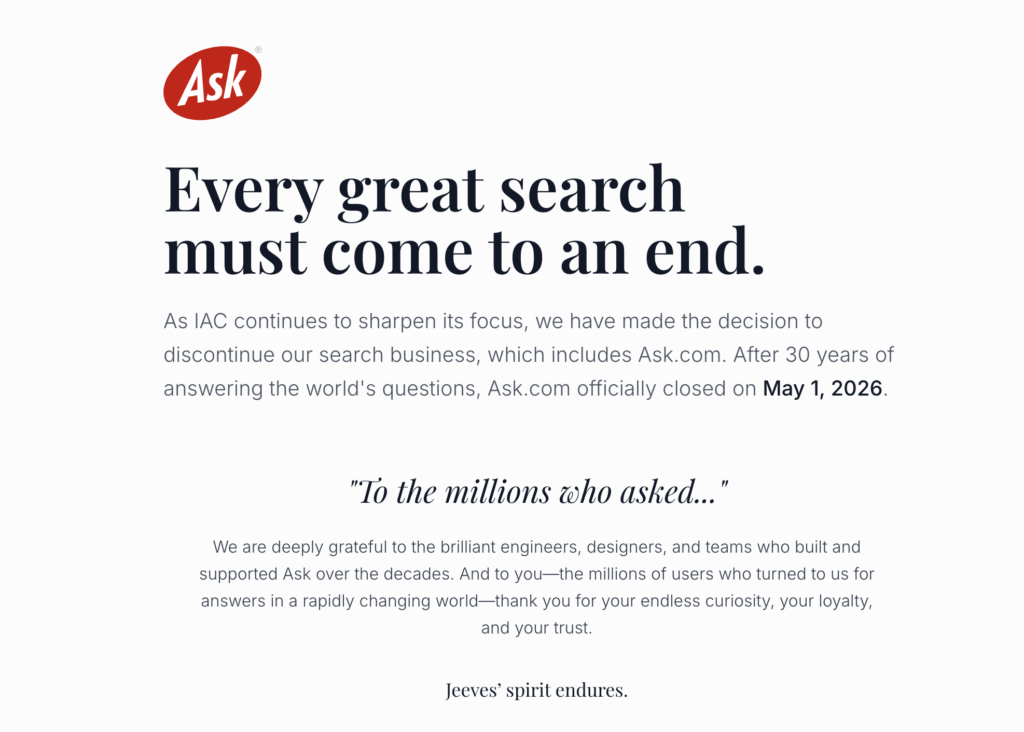
Ask.com officially powered down its servers on May 1, 2026, bringing an end to one of the internet’s longest-running and perhaps most polite search brands. If you were a fan of the site, you’d probably agree it deserves a better obituary than “old search engine finally shuts down.”
After all, for almost 30 years, Ask.com served as the internet’s most dapper concierge, with many still affectionately referring to it by its original name, Ask Jeeves. That iconic early web brand was based on a simple premise: that a search should be a question, not just a keyword.
The Ask Jeeves model was charming, imperfect, and definitely ahead of its time. Ultimately, it failed because it couldn’t deliver the kind of conversational output it was promising. Yet the instincts behind its premise were spot on. Decades later, we’ve come to expect from today’s AI chatbots what we were hoping to get from Jeeves. Now, typing a full question into a box and getting a contextually appropriate answer is beginning to feel like the natural way to use a search engine.
That makes the timing of Ask.com’s disappearance strangely poignant. After more than two decades of being defined by Google’s blue links, rankings, keywords, and search engine optimization, the internet is moving toward the exact behavior that Ask Jeeves envisioned.
In the end, Ask Jeeves lost the search war, but its interface may have been right all along.
Ask Jeeves Made Search Feel Like a Conversation
At a time when the internet was still very much the Wild Wild West, feeling new, strange, and unfinished, Ask Jeeves came along in 1997 to try to tame the chaos.
For those of us old enough to remember dial-up connections, AOL screen names, and the excitement of hearing “You’ve got mail,” our first Internet experiences were anything but user-friendly. The web wasn’t yet a space that people could inhabit without a second thought. It was a maze that required experience to navigate effectively.
The search engines of that time reflect that reality. You typed in clipped search terms, guessed the right keywords, and hoped it understood what you were really looking for. Still, they were an improvement over the even earlier web directories—static lists of links that might or might not work.
In many ways, Ask Jeeves was the more human alternative. When it launched in 1997, Wired described Ask Jeeves as a search engine that accepted “queries in conversational English,” with the company billing it as “the first natural language search agent on the Internet.”
However, its output was far from being an early ChatGPT. Its language parsing was limited and lacked the capacity to reason through an open-ended question like a large language model. Still, as long as you were asking a straightforward who, what, where, or when type of question, you’d get results returned in a form that felt like an answer.
That gimmick helped Ask Jeeves to stand out in a crowded search space. Jeeves gave search a personality at a time when the web itself was still trying to explain exactly what it was. The cartoon Butler promised early internet users what the Internet would eventually become, and that it didn’t have to be just a maze of directories and databases.
Google Taught the Web to Think in Keywords
However, there were no prizes for vision or for being the web’s friendliest interface. Ultimately, it was the most immediately useful engine that won out.
Google came along about a year after Jeeves went live and completely changed what people expected from search. It had a clean design, a PageRank system, and gave people fast, relevant results that helped turn search into the web’s front door.
While Google wasn’t conversational, it did keyword-based searching very efficiently. Yet, rather than adapting to the way people naturally wanted to search, it effectively trained them to search in the way that was most appropriate to the time period. We all learned “proper” search syntax, which meant abandoning full sentences in favor of fragments that distilled our intent down to as few words as possible.
The question “What is the best way to fix my laptop battery?” became “laptop battery not charging fix.”
Google trained us how to meet the machine halfway. We learned how and when to include quotation marks, brands, and other hacks to get the results we wanted. Ultimately, it also trained those who were building the Internet.
Once Google had won the search engine war and become ubiquitous, websites had no choice but to organize themselves according to its logic of search visibility. Headlines, metadata, article structures, product pages, and entire business models were built around what Google could crawl, rank, and surface.
That trend has sometimes been called the “Googlefication” of the internet. Once it had become most people’s de facto interface for using the web, the web had to change itself for Google’s convenience.
With Ask Jeeves, a search was a plain English question; with Google, it became a discipline that people studied and even built their careers around.
As hard as Ask.com tried to survive that shift, it wasn’t to be. The company dropped the Jeeves name in 2006, becoming Ask.com, and tried to modernize and compete in a search market that Google had defined and dominated.
Unfortunately, by moving away from the Jeeves identity, Ask.com lost the most memorable aspect of its brand. Nonetheless, it soldiered on for almost two decades, even as cultural memory remained with the butler.
AI Search Brings Back the Question Box With New Stakes
If Ask.com had gone dark ten years ago, most would’ve chalked it up to another leftover from the dot-com era, finally closing up shop. But in 2026, in many ways, it feels like closing a strange historical loop.
That’s because the question box is back, just in a different form. ChatGPT, Google’s AI Mode, Perplexity, Microsoft Copilot, Gemini, and other AI search tools all encourage us to do what Ask Jeeves once asked of us: type naturally, ask a complete question, and explain what you want. Once the machine has processed your request, you can expect a synthesized answer instead of a long list of links for you to sort through yourself.
Ask Jeeves was in some ways the Internet’s first mainstream rehearsal for this type of search. It didn’t require users to begin their search with keyword translation. You could just type out whatever you were curious about in plain English.
As far as it went, today’s version is much more powerful than Ask Jeeves ever had a chance to be. Modern chatbots summarize information, reorder it, interpret it, and, depending on how you use it, may replace the need to click through to webpages at all. And that is starting to change our relationship with publishers, search engines, and the open web.
With Ask Jeeves, the question was whether it could understand what users were asking it. With AI search, the question is whether we can trust it to give us the right information without hallucinating or lying to us.
Ask.com’s closure is a reminder that the web has been circling the same dream for around 30 years: a computer that can understand a human question and return a useful answer. The dream hasn’t changed; it’s just now we have more powerful systems claiming to be able to do it.
The Butler Is Gone, but the Interface Survived
As we all know, Ask Jeeves didn’t beat Google or come to define modern search infrastructure. Instead, for many users, it became a memory from a bygone era of school computer labs, dial-up connections, and the early weirdness of the web.
Still, that butler understood something important before the internet was ready. Most people aren’t interested in learning search syntax; they just want to ask questions.
For a long time, Google made asking questions unnecessary because its keyword search was extraordinarily good. However, as AI mode appears on Google and Chatbots become the norm, companies are moving away from the traditional web search model.
AI companies are bringing the web back to something that looks surprisingly close to the Ask Jeeves promise, only without the butler, and giving us a lot more control over what we see.
That’s the real legacy of Ask.com. As the final “Thank You” message sits on the Ask.com homepage, it’s worth remembering that long before people were prompting chatbots, millions of early web users were already asking a very polite butler for help.