


 When you buy through affiliate links in our content, we may earn a commission at no extra cost to you. Learn
The AI boom has turned the Internet into a battleground with data as the prize. Publishers, creators, AI tech giants, and data brokers are now fighting over what counts as public information, who has a right to collect it, and what uses of that information require the consent of its creator.
Data scraping isn’t new, but the scale of it is. A decade ago, the average person wouldn’t have foreseen a world in which every publicly available web page is raw material for bots that can write, summarize, code, search, and answer questions.
But here we are, and few companies sit closer to the epicenter of that fight than Bright Data. The company operates one of the world’s largest public web data platforms and helps customers scrape publicly available information for market research, cybersecurity, price comparison, and AI.
Rony Shalit, Bright Data’s Chief Compliance and Ethics Officer, says his side of the argument hinges on a simple principle.
“The World Wide Web in general is the biggest database humankind ever had,” he told Techopedia in an interview.
From his perspective, publicly available data supports everything from journalism and cybersecurity to price comparison and AI development — and the emphasis is on public.
But access is only one side of the fight.
Matthew Butterick, an attorney representing plaintiffs in several major AI copyright cases, disagrees. He says the public availability of web data doesn’t imply a right for companies to use it however they like.
When Techopedia asked Butterick whether publicly available content can be used to train AI models without permission or compensation, his answer was brief and to the point:
“In my view — no,” he said.
As AI becomes increasingly hard to avoid, the question of acceptable use is more important than ever. Most relevant laws did not ancitipate this situation, so it may come down to the courts to draw the line.
Bright Data Says Public Web Access Keeps The Internet Useful
Shalit doesn’t view scraping as anything scandalous in and of itself. It’s just one of the ways that companies, researchers, journalists, and developers collect public information at scale.
“Scraping was around long before AI,” he said. “It has not changed the way scraping is done. It did change the way data is used.”
He believes much of the current debate over AI and web scraping overlooks the important role that public data plays across the internet. AI didn’t create the demand for public web data, but it made questions around that demand a lot harder to ignore.
“AI made the big shift of understanding how much data there is and how it’s actually being used,” he told Techopedia.
Journalism was one of the examples he used to make his point. Comparing public records, company websites, and archived material to verify information and hold organizations accountable is a routine part of many reporters’ jobs.
Historical archives like the Internet Archive’s Wayback Machine use web crawlers to capture and save snapshots of publicly accessible web pages long after the originals are changed or removed.
“The importance of the Wayback Machine … is really, you need to use it to understand how critical it is,” Shalit said. “It’s not just about whether a company said something or a person said something. That’s very important, but it’s also about whether a publisher starts changing its own articles.”
Of course, the Wayback Machine is controversial in its own right, and many media companies have tried to block it.
Shalit argues that if publishers, platforms, and other site owners start restricting access too aggressively, they could limit those public benefits as well as AI development.
Some AI Use Cases Are More Controversial Than Others
But Shalit was also clear that defending access to public web data does not mean treating every downstream use as a free-for-all.
“Accessing the data, it’s one thing. How you use the data is a different thing,” he said.
After all, the same kinds of public data that can help a journalist investigate corruption, a consumer compare hotel prices, or a medical researcher study disease trends can also feed an AI company building a large language model.
Just because they all begin with public data doesn’t mean they should all be treated the same, says Shalit.
However, he worries that efforts to stop controversial uses of AI could have the unintended effect of locking down too much of the web’s public data.
“If we start closing the gates and having less publicly available data, that means we only magnify that bias that is out there,” he said.
Medical AI is one of the examples he gave. If there is less online information about medicine, practices, and statistics in African countries, he said, AI systems may be less likely to recognize symptoms or practices specific to those regions. Without enough data, he argued, AI can become “biased by default.”
AI Copyright Lawyers Say Public Does Not Mean Free To Use
As AI copyright litigation moves through the courts, the difference between access and use has become one of the central questions.
On his law firm’s website, AI copyright attorney Matthew Butterick says his own work, like that of many authors, artists, and programmers, was copied into commercial generative AI training datasets “without consent, credit, or compensation.”
And in a 2024 article, Butterick argued that even if an LLM doesn’t plagiarize a writer’s work outright, it can still damage that writer’s business by delivering the same “informational value” without sending readers back to the original source.
“To be fair, if a human reader copied my writing to deliberately create a market substitute, I wouldn’t consider that ‘learning’ either,” Butterick wrote. “I would consider that a ripoff—financially, morally, legally.”
Fair use rulings depend in part on whether the use is “transformative,” meaning whether it serves a different purpose than the original. U.S. courts have gone both ways on whether the use of copyrighted material for AI training is transformative.
When Techopedia asked whether current copyright laws are equipped to handle the issue, Butterick pointed to the number of such cases already moving through the courts.
“We’re going to find out,” he said. “There are now apparently over 100 AI-related copyright cases pending. I am co-counsel in eight.”
That backlog of cases is testing how copyright law applies when AI developers collect and use online material on the massive scale we’ve seen in recent years.
Publishers, authors, artists, and other creators argue that putting their work online doesn’t give AI companies the right to extract commercial value from it without permission, licensing agreements, or compensation.
And it’s that argument that’s running head-on into a long-standing principle of the internet: if information is public, others can find it, index it, archive it, compare it, and build tools around it.
What’s still up in the air is whether that assumption can survive unchanged in the AI era.
Court Fights Are Testing What Public Access Means
Bright Data has already had its day in court over public web scraping. Meta and X both sued the company over its collection of public data, and Shalit said Bright Data saw those cases as bigger than its own business.
“It’s not about Bright Data, it’s about the industry as a whole,” he said. “Access to public data is critical, and we must have that stand.”
In January 2024, a federal judge granted Bright Data summary judgment on Meta’s breach-of-contract claim, finding that Bright Data didn’t violate Meta’s terms by scraping publicly available Facebook and Instagram data while logged out. X’s complaint against Bright Data was dismissed months later.
While the ruling didn’t answer every question around AI scraping, copyright, or commercial use, it did make clear that, under Meta’s terms, data visible while logged out wasn’t the same as information behind an account or password.
A separate lawsuit accusing Apple of bypassing YouTube’s limits to collect publicly available videos for AI training shows how quickly the public-access debate can turn technical.
In a July 1 motion to dismiss the case, Apple argued that the Digital Millennium Copyright Act distinguishes between controlling access to a work and limiting what someone can do with it once it is already public.
Apple said the plaintiffs posted videos to YouTube that “any member of the public” could see, with “no password,” “no payment,” “no lock,” and “no key.”
The company argued that the complaint describes measures designed to stop scraping, unauthorized downloading, bulk extraction, and data mining. But Apple says those limits apply to use, not access to the videos themselves.
The plaintiffs see things differently, arguing that protections against scraping and downloading are designed to stop companies from taking content at scale, even if an ordinary viewer can still watch the video.
The court hasn’t ruled on the case yet, but it shows why this access-versus-use line is becoming so important. As AI companies seek more data and creators push back, judges are being asked to decide what “public” really means online.
Bright Data Says Ethical Scraping Requires Consent And Controls
“Clear consent is a must,” Shalit said, regarding the use of intermediaries to facilitate scraping.
Bright Data recently made headlines after security researchers at Include Security raised questions about how its SDK works.
The SDK can be embedded in partner apps and, with user consent, turn smart TVs and other consumer devices into residential proxy nodes, routing third-party web-scraping requests through a user’s home internet connection.
Shalit says that’s exactly why he believes consent should never be buried in an app’s terms of service.
“We understand that people don’t read the terms and conditions,” he said. “So we want it to be in your face. We want you to know. We want you to have information.”
To see if Bright Data’s consent was as “in your face” as Shalit said it should be, Techopedia tested two apps (JellyJump and Archery Go 2025) that allow users to share their device’s free resources and IP address to download public data from the internet for the company.
The consent screens appeared immediately after we opened the apps and included links users could tap to learn more about how Bright Data uses shared resources for web indexing. Jelly Jump gives users 500 in-app coins for opting in, while Archery Go 2025 offers to unlock the full game and two bows.
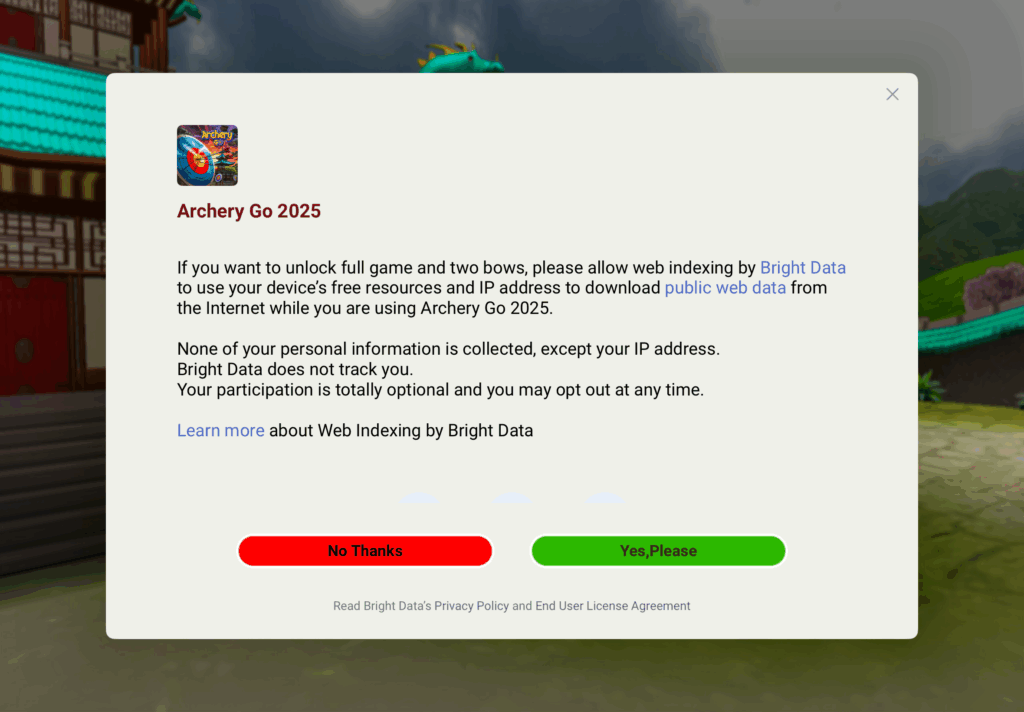
Beyond consent, Shalit also said that responsible scraping involves more than just asking users to opt in. Bright Data also screens its data-scraping customers, reviews their use cases, monitors activity, keeps logs, and blocks customers who don’t follow its rules.
“We have full logs of what is being done in our network,” he said. “You want to be able to monitor, to detect, to investigate.”
Just having those rules on paper isn’t enough, he told Techopedia.
“It’s not just about having a policy,” he said. “You need to enforce it.”
Shalit acknowledged that there are bad actors in the scraping industry, including companies that use people’s devices without real consent or use misleading prompts to obtain consent.
But he said that’s an argument for stronger controls, and that those abuses don’t mean that responsible scraping is impossible.
“Responsible and ethical data collection is not a nice thing to have,” he said. “It’s a must.”
While that doesn’t answer the question Butterick and other lawyers are pressing in court, it does show why the debate has moved past whether public web data can be useful.
As the fight continues, the questions are who gets to scrape that data, who gets to profit from it, and what protections need to be in place before that collection even begins.