


 When you buy through affiliate links in our content, we may earn a commission at no extra cost to you. Learn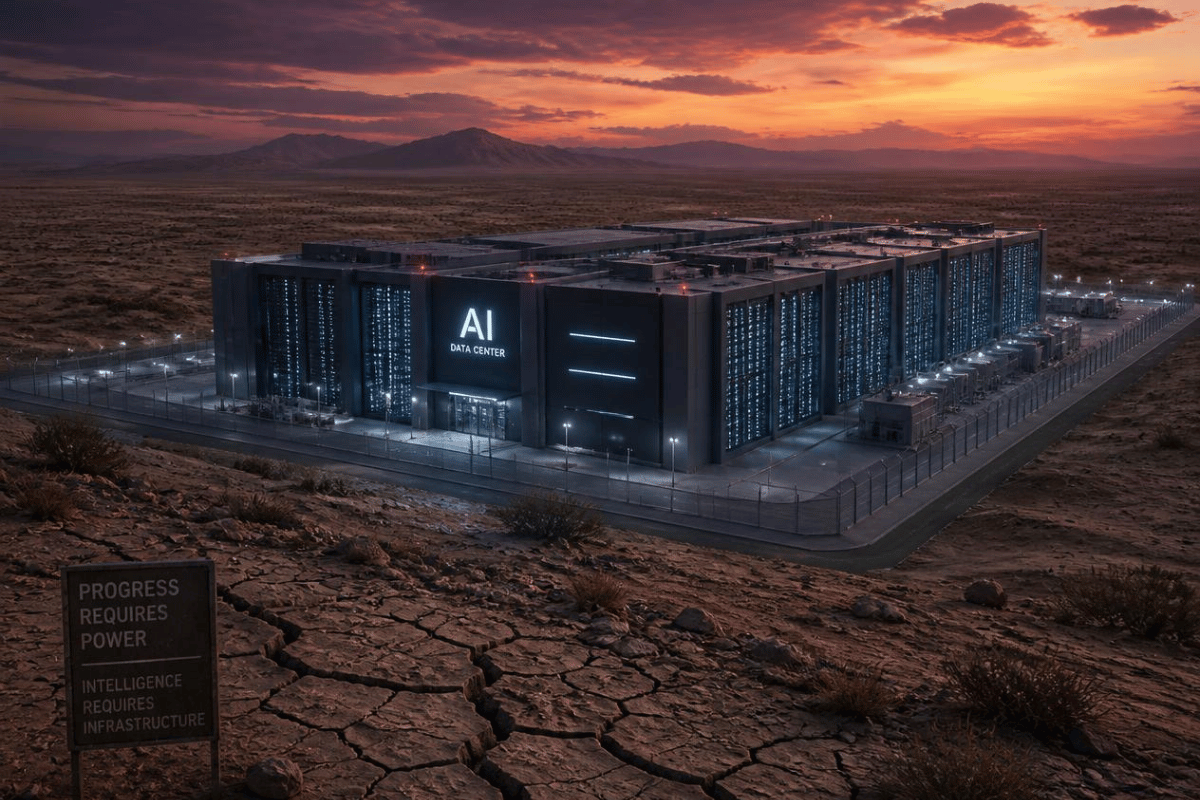
“The promise that ‘AI will save the planet’ is a paradox when the AI [data center] itself requires boiling oceans to operate.”
While tech companies pitch AI as the tool that could optimize energy use, tackle climate change, and solve humanity’s biggest problems, the digital backbone supporting that vision is consuming huge amounts of electricity and water while driving demand for land and raw materials.
It is not exactly the kind of slogan you will find in a Silicon Valley investor pitch deck, but co-founder and CEO of Mind Simulation Lab Leo Derikiants said the contradiction lies at the center of the artificial intelligence boom.
Across the United States, data centers — those anonymous warehouse-like buildings quietly powering our digital lives — are becoming increasingly difficult to ignore. Data centers used to attract little public attention. Now they are becoming flashpoints in local communities.
Recent reports showcase growing public concern, from renowned consumer advocate and environmental activist Erin Brockovich urging residents to report environmental complaints linked to nearby data centers, to allegations in Georgia that construction tied to a Meta facility contributed to brown tap water in surrounding homes.
The Generative AI Boom Is Fueling the Expansion of Data Centers
The buildout is being driven largely by generative AI, whose enormous appetite for computing power has triggered what some experts describe as an infrastructure arms race.
“The current gigawatt-scale data center boom is almost entirely driven by the brute-force architecture of modern Generative AI,” Derikiants told Techopedia. “Trillion-parameter models are trapped in what we call the ‘AI Scaling Trap.’”
“We are reaching the limits of Earth’s power grids, which is exactly why tech leaders are now floating absurd ideas like space-based solar farms or reopening nuclear plants just to power predictive text engines.” – Leo Derikiants, Mind Simulation Lab CEO
Today’s AI systems are incredibly powerful, but they are also incredibly hungry. Training and running large models requires giant clusters of GPUs operating around the clock, burning through huge amounts of electricity while demanding industrial-scale cooling systems to stop everything from melting into an expensive puddle.
Derikiants argues the industry’s current path is “physically unsustainable,” warning that energy grids are already creaking under the pressure as technology companies scramble for more power sources to feed AI growth.
“AI is turning data centers from quiet back-office infrastructure into one of the fastest-growing power loads on the grid,” said Mark Norman Vena, CEO and principal analyst at SmartTech Research.
He pointed to International Energy Agency projections showing global data center electricity use could more than double to roughly 945 terawatt-hours by 2030, with the demands of AI accounting for most of the increase.
Vena said communities are struggling with both the scale and speed of new developments.
“One hyperscale campus can land like a factory, a city block and a power plant all showing up at once,” he said, describing what he called “local grid shock.”
As companies race to build larger and more capable AI systems, critics are increasingly questioning whether sustainability pledges are able to function in reality.
The Environmental Cost of Building AI Data Centers
According to Flexential’s 2026 State of AI report, 67% of decision-makers at technology firms believe that renewables will supply ‘most’ of the energy to power artificial intelligence within the next five years, but experts argue those claims can sometimes rely more on accounting than physics.
“Buying clean power on paper is not the same as delivering clean, additional electricity to the same grid at the same hour the data center is burning through megawatts,” Vena said.
Then there is the water problem.
“The real issue (and it’s HUGE) is not just national electricity demand. It is local grid shock, where one hyperscale campus can land like a factory, a city block and a power plant all showing up at once.” – Mark Norman Vena, SmartTech Research CEO
Data centers require enormous cooling systems. In many cases, that means huge quantities of fresh water evaporating into the air so servers can keep generating chatbot responses, AI images, and endless streams of marketing content.
Derikiants was particularly blunt about what he sees as the mismatch between AI’s real-world usefulness and its environmental footprint.
“Using tens of thousands of kilowatt-hours and millions of liters of fresh water for server cooling just to generate marketing copy or hallucinate facts is a profound waste of planetary resources,” he said.
And environmental experts warn that the construction of the facilities themselves carries a heavy ecological price tag, from land use and raw material extraction to biodiversity loss and pressure on local ecosystems.
Andrew Hulbert, a sustainability expert and built-environment entrepreneur, said the industry often focuses too narrowly on operational emissions while overlooking the wider ecological cost of constructing these facilities in the first place.
“The environmental cost of constructing and expanding buildings must include consideration of raw materials, land use, biodiversity loss, and water consumption,” Hulbert said. “True sustainability requires assessment of the full lifecycle impact, not just operational energy.”
Rapid proliferation, he added, risks putting speed and investor pressure ahead of long-term planning.
“Building data centers and infrastructure can reduce biodiversity, displace wildlife, and place pressure on local communities and ecosystems,” Hulbert said.
The Human Aspect Behind AI Supply Chains
Another concern sits further up the supply chain, i.e., the mining of critical minerals needed for servers, batteries, cooling systems, and electrical infrastructure.
Eleanor Harry, CEO of the HACE Child Labour Network, warned that many of the same minerals underpinning both the AI boom and the clean-energy transition are linked to exploitative labor practices, including child labor in informal mining operations.
“Companies relying on critical mineral supply chains must address the lack of resilience that child labor poses to their operational activity; i.e. if we want to get to Net-Zero by 2030, how can we do that when children are pulling the minerals out of the ground?” – Eleanor Harry, HACE CEO
“Technology hardware, including AI data centers, is a primary focus because its supply chains are exceptionally deep, often reaching into unregulated or informal extractive sites for many raw materials, where child labor is prevalent,” Harry said.
She noted that while companies are increasingly eager to promote their emissions targets and sustainability branding, far less attention is often paid to labor conditions buried deep within global supply chains.
“Focusing exclusively on environmental metrics while ignoring the human cost of hardware increases the risk of greenwashing claims,” she said.
Supporters of AI argue the technology could still ultimately reduce emissions by improving logistics, optimizing energy systems, accelerating scientific discovery, and making industries more efficient.
Can Utilities Keep Pace With AI Growth?
Authors of Green and Intelligent: The Role of AI in the Climate Transition state that AI could reduce global emissions of greenhouse gases by 3.2 to 5.4 billion tonnes of carbon-dioxide. One of the lead researchers, Mattia Romani, added: “Our research shows that with the right collaboration—between governments, tech companies, and energy providers — AI can be harnessed to accelerate climate action, not hinder it.”
Critics, however, say those future possibilities do not magically erase the very real environmental costs piling up today.
For policymakers and utility providers, the bigger challenge may simply be keeping up.
“Utilities are being asked to plan for AI demand that is moving faster than permitting, transmission buildout and generation interconnection,” Vena said. “That creates a brutal mismatch between Silicon Valley timelines and utility-sector reality.”
Even some AI researchers believe the industry’s current trajectory may not be sustainable forever. Derikiants said alternative AI architectures could eventually reduce computing demands dramatically, although those systems remain largely experimental for now.
Until then, the race to dominate artificial intelligence continues to drive an extraordinary wave of physical development — one increasingly visible not just in stock prices and product launches, but in power grids, water systems, mining operations, and local communities.
AI is already reshaping society. Whether power grids, water supplies, and local communities can keep pace is another matter.