

 When you buy through affiliate links in our content, we may earn a commission at no extra cost to you. Learn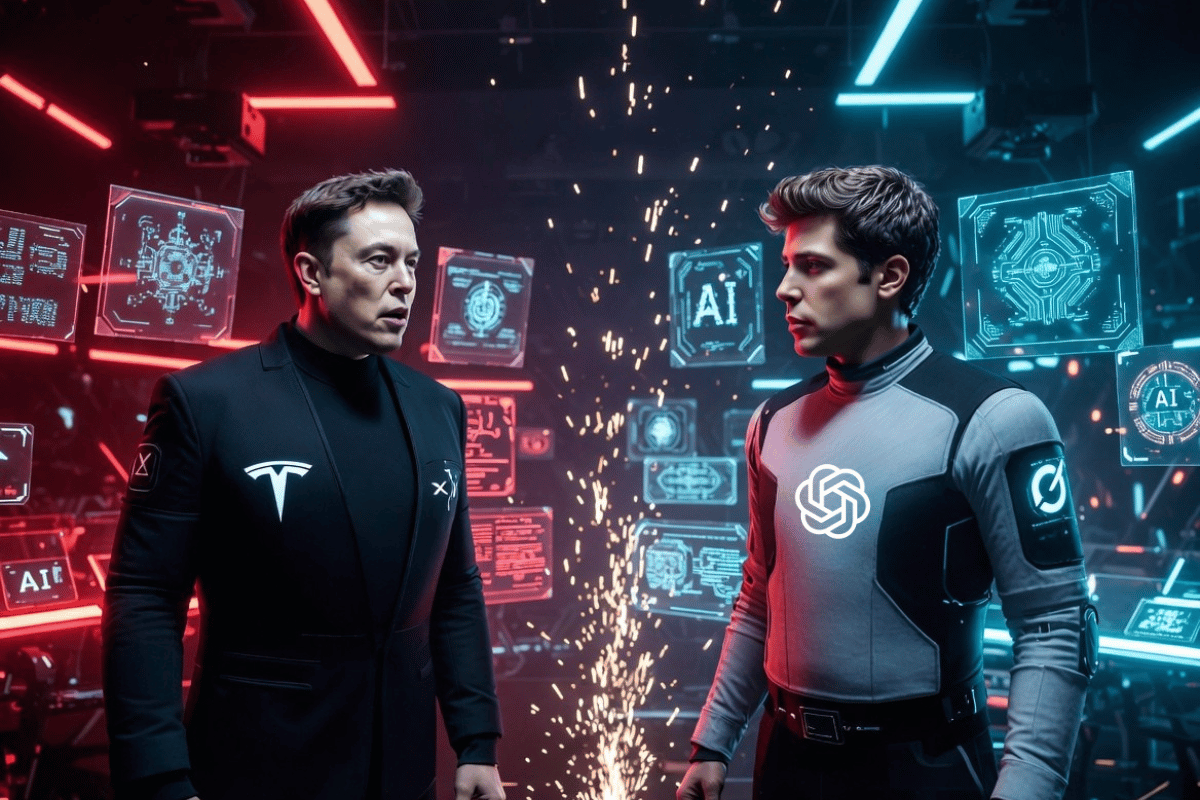
The AI industry’s biggest battle right now is happening inside a California courtroom, where Sam Altman finally took the stand to defend OpenAI against a lawsuit brought by former co-founder Elon Musk over the company’s dramatic corporate transformation.
The case focuses on whether OpenAI abandoned the nonprofit principles it was founded on in pursuit of unlimited commercial growth. What started as a disagreement over how artificial intelligence should be developed has turned into a much larger fight over money, power, and control of OpenAI’s original mission.
In a new court filing, OpenAI accused Musk of rewriting his legal strategy midway through trial after earlier minimizing concerns about the company’s controversial 2025 restructuring. According to the document, the Tesla CEO initially told the court the recapitalization would play only a limited role in the case before making it a centerpiece of testimony and opening arguments.
The restructuring itself remains the core issue.
OpenAI moved away from its widely discussed “capped-profit” framework and reorganized into a public benefit corporation that removed formal limits on investor returns. Musk’s legal team argued that the change fundamentally changed the company from a nonprofit AI lab into what Musk described as a machine for “infinite profits.”
Now OpenAI appears to be escalating its response.
The company told the Northern District of California that Musk’s earlier arguments focused heavily on Microsoft investments made between 2019 and 2023, but those claims weakened under statute-of-limitations scrutiny.
Altman: Musk Suggested His Children Should Inherit OpenAI
OpenAI argues Musk pivoted his attack toward the company’s restructuring only after his earlier claims proved difficult to support. Altman said in court that the company had “created one of the largest charities in the world. This foundation is doing incredible work and will do much more.” He also described a “hair-raising moment” when Musk reportedly said OpenAI should be passed on to his children if he died.
During the trial, former OpenAI board member Shivon Zilis, who has four children with Musk, testified about her complicated relationship with the world’s richest man. California family lawyer Alphonse Provinziano told Techopedia: “From what we know, Musk had a pre-nup and a financial agreement in two of his marriages, a private sperm donation contract, and a non-disclosure agreement with Shivon Zilis.
“The confidentiality clause suggests there may be even more children that we don’t know about. There are definitely more legal agreements that can function like a pre-nup, except that you don’t intend to get married. You might even think of these as ‘no-nups.’”
The filings also revealed how closely regulators examined the deal.
OpenAI said both the California and Delaware attorneys general spent months reviewing governance changes, valuation terms, and nonprofit protections tied to the restructuring. In the end, neither office challenged the transaction. OpenAI now wants jurors to hear that regulators signed off on the deal after extensive negotiations rather than viewing it as a hostile takeover of a nonprofit entity.
The company’s lawyers are pushing for Altman and board chairman Bret Taylor to testify that state officials required specific modifications before approving the structure. The AI giant argues Musk cannot simultaneously frame himself as the sole protector of the company’s charitable mission while excluding evidence that government regulators responsible for nonprofit oversight accepted the revised structure.
The implications stretch well beyond one Silicon Valley feud.
Musk warned jurors the lawsuit could shape whether nonprofits across the United States can eventually be stripped of their missions by insiders chasing commercial upside. OpenAI rejected that framing. The company argued the lawsuit is less about protecting humanity and more about a former founder trying to regain leverage after losing influence inside the company he helped create.
Also in Tech News
Homeland Security Committee Probes Instructure After “Matter of National Concern” Cyberattacks
The U.S. House Committee on Homeland Security is investigating Instructure Holdings after two cyberattacks hit its Canvas learning platform within the span of a week, according to a May 11 letter sent to CEO Steve Daly.
Lawmakers said the attacks, allegedly linked to cybercrime group ShinyHunters, exposed sensitive student and faculty data before escalating into wider disruptions that affected schools during final exam season. Canvas has more than 30 million active users globally across roughly 8,000 institutions, making the incident “a matter of national concern,” the Committee wrote.
Instructure disclosed on May 1 that threat actors accessed student names, email addresses, identification numbers, and messages exchanged through the platform. The company said passwords and financial information were not compromised. However, the Committee said ShinyHunters later claimed to possess records tied to “approximately 275 million students, teachers, and other staff across nearly 9,000 institutions worldwide.”
The investigation intensified after a second alleged intrusion on May 7, when attackers reportedly “inject[ed] ransom demands directly into Canvas login pages across institutions nationwide.” Schools and universities in at least 11 states were affected during final examinations and end-of-semester deadlines.
The Committee is now pressing Instructure on whether it fully addressed vulnerabilities after the first attack and has requested additional details about the company’s incident response efforts.
Your House Might Become Part of the AI Cloud

As the AI industry continues to obsess with building bigger data centers, San Francisco startup SPAN thinks the faster move is building smaller ones — everywhere.
This week, the company announced XFRA, a distributed data center platform that places compact AI compute systems inside homes and small commercial buildings instead of relying entirely on giant centralized campuses.
The concept sounds futuristic, but the pitch is surprisingly straightforward: millions of buildings already have unused electrical capacity sitting idle for most of the day. XFRA plans to tap that hidden power and turn it into a massive network of “mini data centers” spread across neighborhoods.
Think less “server farm in the desert” and more “quiet AI appliance connected to your electrical panel.”
According to SPAN, these residential compute nodes could help AI companies expand much faster than waiting years for new utility-scale infrastructure and hyperscale campuses to get approved and built. The company says the system is designed to close the growing “speed-to-power” gap now slowing AI expansion.
The idea also reframes what a smart home could become. Instead of only consuming electricity, homes could partially function as infrastructure for cloud computing, especially AI inference workloads that benefit from being physically closer to users.
If the model works at scale, the next phase of AI may arrive through thousands of ordinary houses quietly running pieces of the internet from the edge of the grid.
Google Wants to Move AI Infrastructure Beyond Earth
Just days after startups pitched turning ordinary homes into distributed AI infrastructure, Google is reportedly exploring something even more ambitious: moving parts of the cloud into space.
According to people familiar with the discussions, the deal would support Google’s “Project Suncatcher,” a moonshot initiative focused on deploying prototype orbital computing satellites by 2027. The company is already working with Planet Labs on the effort.
The timing reflects a growing industry reality that Earth-based data centers are running into limits around land, power, and construction timelines just as AI demand explodes.
While startups like SPAN are attempting to distribute compute capacity across homes and neighborhoods, Google and SpaceX appear to be looking upward instead. Orbital data centers would theoretically operate using continuous solar power in space, reducing some of the energy and environmental pressures tied to terrestrial AI infrastructure.
The concept remains highly experimental, however. Engineers still face major questions around cooling systems, hardware reliability, launch economics, and maintenance in orbit.
SpaceX CEO Elon Musk has reportedly positioned orbital computing as the company’s next major frontier ahead of its anticipated IPO this summer.
The company has already moved aggressively in the category, recently announcing partnerships tied to AI infrastructure and filing plans to deploy up to one million satellites connected to its orbital data-center ambitions.
The future AI cloud may not live in one place at all.