

 When you buy through affiliate links in our content, we may earn a commission at no extra cost to you. Learn
Since the early days of the Internet, online games have struggled with the issue of peer-to-peer chat abuse, but AI might provide the answer.
The bigger the game, the more difficult moderation becomes, and the inception of voice chat compounded the issue. It is simultaneously more emotional and more difficult to moderate at scale. It’s much harder to keep track of what’s being said or to store logs for later review. That is why Aiba is pushing its Amanda system as the direction in which it thinks moderation will be heading in the coming months and years.
Aiba has partnered with 4Players to bring Amanda into ODIN, the company’s voice chat platform, to add an AI moderation layer to live voice conversations. It’s designed to detect patterns that point to potential grooming, bullying, radicalization, or any of a number of other forms of abuse. It can alert human moderators even before players report the problem manually, assuming they do at all.
Historically, moderation relies on reporting by players, which may come only after the game is over. By then, the damage may already have been done, especially in games and social platforms with younger audiences. Amanda is designed to look for patterns across a conversation, rather than the traditional technique of flagging banned words or isolated insults. A single harmless-sounding line may mean little on its own, but repeated attempts to isolate a player, move them to another platform, or build inappropriate trust can indicate a serious problem when taken as a whole.
This is one of the major technical challenges around safety in voice chat. Text moderation can scan messages directly, apply filters, compare phrases, and escalate cases to appropriate authorities if need be. Voice moderation has to deal with speech recognition, accents, ever-moving internet slang, background noise, different languages, interruptions, sarcasm, and tone. It also has to work quickly enough to be useful without becoming so heavy-handed that ordinary player chatter and trash-talk get flagged constantly.
Aiba says Amanda can operate across text and voice and looks to detect escalating behavior rather than just keywords, and route difficult cases to human moderators. The company also says the system supports compliance reporting for regulations such as COPPA, the EU’s Digital Services Act, and the controversial UK Online Safety Act. Game studios are increasingly being asked to show that they have systems, logs, processes, and escalation routes in place when harmful behavior occurs, and often face massive penalties if they don’t.
For publishers facing such pressure, the lure of AI assistance is obvious. Live-service games can generate enormous volumes of chat. It is impossible and unethical for human teams to listen to everything in real time. That being the case, most harmful behavior is never reported and possibly. In some cases, even the victim might not recognize the threat in time. An AI triage system can potentially push the worst cases to the front of the queue, reduce the amount of routine moderation work, and help studios spot patterns across a community.
Grooming And Radicalization Take Place Over Multiple Sessions
There is also a particular relevance for games with open social spaces. Grooming and manipulation are not always glaringly obvious. They may happen gradually, over multiple conversations, and can be hard to identify from a single report. Any system that claims to detect early warning signs, therefore, has to understand context over time, not just vocabulary.
At the same time, this is the kind of technology that needs careful handling. AI moderation brings its own risks, not least false positives, cultural misunderstanding, and privacy concerns. There is also a danger of studios treating automation as a replacement for proper safety teams. Aiba has been clear that human moderators still need to be involved and that in sensitive cases, especially those involving children, a machine should not be the final authority.
Privacy is another major issue. Aiba says its approach stores voice data only when harmful speech is detected, but any studio using this kind of tool will still need to explain its policies clearly to players and parents, and even then, we have to trust them.
Even with those concerns, the direction of travel seems clear. Voice chat is an essential part of today’s online play, while safety expectations are rising. Games are no longer just selling content; many are running social spaces. Once a game becomes a place where strangers talk, compete, trade, role-play, or hang out, moderation becomes part of the infrastructure.
Amanda’s big pitch is that some forms of online harm can be detected earlier and handled more systematically. Whether it works well enough in live games will depend on accuracy, transparency, and how developers implement it. But the broader shift is already happening. Moderation is moving from the edge of game operations into the main technology stack itself.
Also in Gaming News
California’s Protect Our Games Act Pushes Game Preservation Into Law
California’s AB 1921, also known as the Protect Our Games Act, has passed the State Assembly by 43 votes to 16 and now heads to the State Senate. Backed by the Stop Killing Games movement and introduced by Assembly Member Chris Ward, the bill is one of the most significant attempts yet to turn the debate around dead online games into law.
The bill is aimed at paid digital games that depend on online services controlled by the operator. According to the current California legislative text, for games first sold or re-released from January 1, 2027, operators would need to give 60 days’ notice before shutting down services necessary for ordinary use. Once those services end, they would also need to provide an alternate version, a patch or update, or a refund. The bill would also stop operators from selling or distributing a version of a game that cannot be used independently of services controlled by the operator, subject to exceptions.
The games industry has never really settled what buying a digital game should mean when that game depends on remote servers. A traditional boxed game may have needed patches or online features, but it could often still exist as a playable thing after the publisher moved on. Many modern games are different. If authentication servers, matchmaking services, progression systems, or core online infrastructure disappear, the product people paid for can effectively vanish with them.
The Protect Our Games Act tries to create an end-of-life framework for that problem. It does not simply say publishers must keep every server online forever. Instead, it pushes them toward planning for shutdowns before they happen. That might mean an offline mode, a patch that removes server dependency, limited community server support, or refunds where continued access is not possible.
For developers and publishers, the technical questions are far from trivial. Some games are built around server-side logic, licensed content, anti-cheat systems, economies, user accounts, or live operations tools that were never designed to be handed over or simplified later. The industry-led Entertainment Software Association has opposed the bill, arguing that it could force companies to spend limited time and resources maintaining older infrastructure instead of building new games, features, and technology.
Preservation advocates see AB 1921 as a basic consumer protection measure for paid games. Industry groups see it as a potentially costly requirement that may not fit how live-service games are built. The technical middle ground is probably where the real debate sits: if a game is sold for money and depends on remote services, should end-of-life planning be part of the design from the beginning?
For players, the bill is about not losing access to something they bought. For the industry, it is a warning that digital ownership is more than just a storefront wording issue or a line in an EULA that players don’t read and agree to. If games keep becoming services, lawmakers may start asking what responsibilities come with selling them.
Custom PC Builds Are Becoming Small-Scale Tech Theatre
A skyscraper-shaped custom PC spotted at Computex by PC Gamer is not the most serious gaming hardware story of the week, which is exactly why it is useful. Sitting alongside debates about AI moderation and digital ownership, it shows another side of PC gaming technology: the culture of building, modifying, and turning hardware into something closer to an exhibit.
The build, shown at Hyte’s Computex booth, is based on a Hyte Y70 Touch case and transforms the machine into a miniature Taipei night market scene. Its centerpiece is a light-up, 3D-printed recreation of Taipei 101, complete with a tiny climber attached to the side. Around the base are small shopfronts, street signs, air conditioning units, hand-painted Hokkien-style roofs, and even a tiny food stall selling Taiwanese sausage with sticky rice.
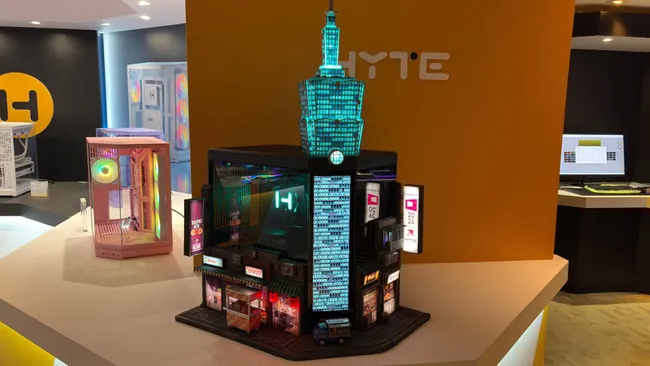
On one level, this is just a very elaborate case mod. On another, it says something interesting about where gaming PCs sit now. A high-end PC is still a performance machine, but it is also furniture. For many enthusiasts, the visual design of the system has become part of the hobby rather than an afterthought hidden under the desk. When Valve showed off its Steam Machine at the end of last year, one of the selling points was user-interchangeable faceplates for the box.
Custom builds like this one rely on accessible 3D printing, lighting control, touchscreen displays, compact component layouts, and a growing ecosystem of cases designed to be shown off rather than hidden away. The Hyte Y70 Touch is already built around a prominent display panel, and this build uses that screen to create the illusion of elevators moving through the miniature skyscraper.
The rise of this kind of build also mirrors broader changes in gaming hardware marketing. At events such as Computex, raw specifications still matter, but they are not always enough to get attention. A creative custom PC can communicate brand identity, regional culture, hardware flexibility, and maker skill in a way a spec sheet cannot.
Few people are going to commission a miniature city block around their GPU. But that is not really the point. Custom PCs are increasingly where engineering, craft, fandom, and hardware design meet. This Taipei 101 build is silly, charming, and wildly impractical, but it also shows why PC gaming has always had a different relationship with hardware. The machine itself can be part of hobby, whereas that old Xbox or PlayStation are just tucked away out of sight..
Nintendo’s Replaceable Battery Shows Impact of Regulation on Console Design
Nintendo is preparing revised Switch 2 hardware for Europe with replaceable batteries, which is a big win for those who don’t want to consign their consoles to e-waste at the end of their useful, rechargeable life.
The move is tied to new European Union battery rules that come into effect on February 18, 2027. The regulation requires batteries in certain appliances sold in the EU to be easily replaceable by end users during the lifetime of the product. Pesky old EU and putting the interests of the consumer first. Nintendo has said it is preparing compliant versions of products with model numbers beginning “BEE,” with future packaging set to include a separate “OSM” code to mark them as distinct regulatory versions.
Obviously, Switch 2 is not just a console in the traditional sense. It is a handheld computer, a dockable living-room device, a tablet-like screen, and part of a wider controller ecosystem. Its battery is central to the product’s lifespan. Once that battery degrades, the device becomes less useful, even if the screen, processor, buttons, and game library still work.
The regulation may also reach beyond the main Switch 2 unit. Joy-Con 2 controllers and the Switch 2 Pro Controller also use BEE model numbers and include built-in batteries, raising the possibility that future European versions of those accessories may need to be easier to open and repair as well.
For players, the benefit is huge. A replaceable battery can extend the life of your expensive hardware and reduce the need to send devices away for service or replace them entirely. Manufacturers now need to be thinking about how user-replaceable batteries might affect product thickness, internal layout, waterproofing, durability, heat management, and assembly costs. Modern handhelds are packed tightly, and every millimetre inside the shell is contested ground.
Right-to-repair has often been treated as a phone or laptop issue, or even on a larger scale with machinery such as tractors, but gaming devices are now part of the same conversation. Handheld consoles, controllers, VR headsets, and PC gaming portables all depend on batteries that will eventually wear out.
Nintendo’s European plans may not immediately change every Switch 2 sold worldwide, but EU rules have a habit of shaping global product design. If one market demands easier repairability, companies then have to decide whether to build separate regional models or make the repairable version the new normal. It’s either that or risk being accused of selling an inferior product to the other marketplaces around the world.