


 When you buy through affiliate links in our content, we may earn a commission at no extra cost to you. Learn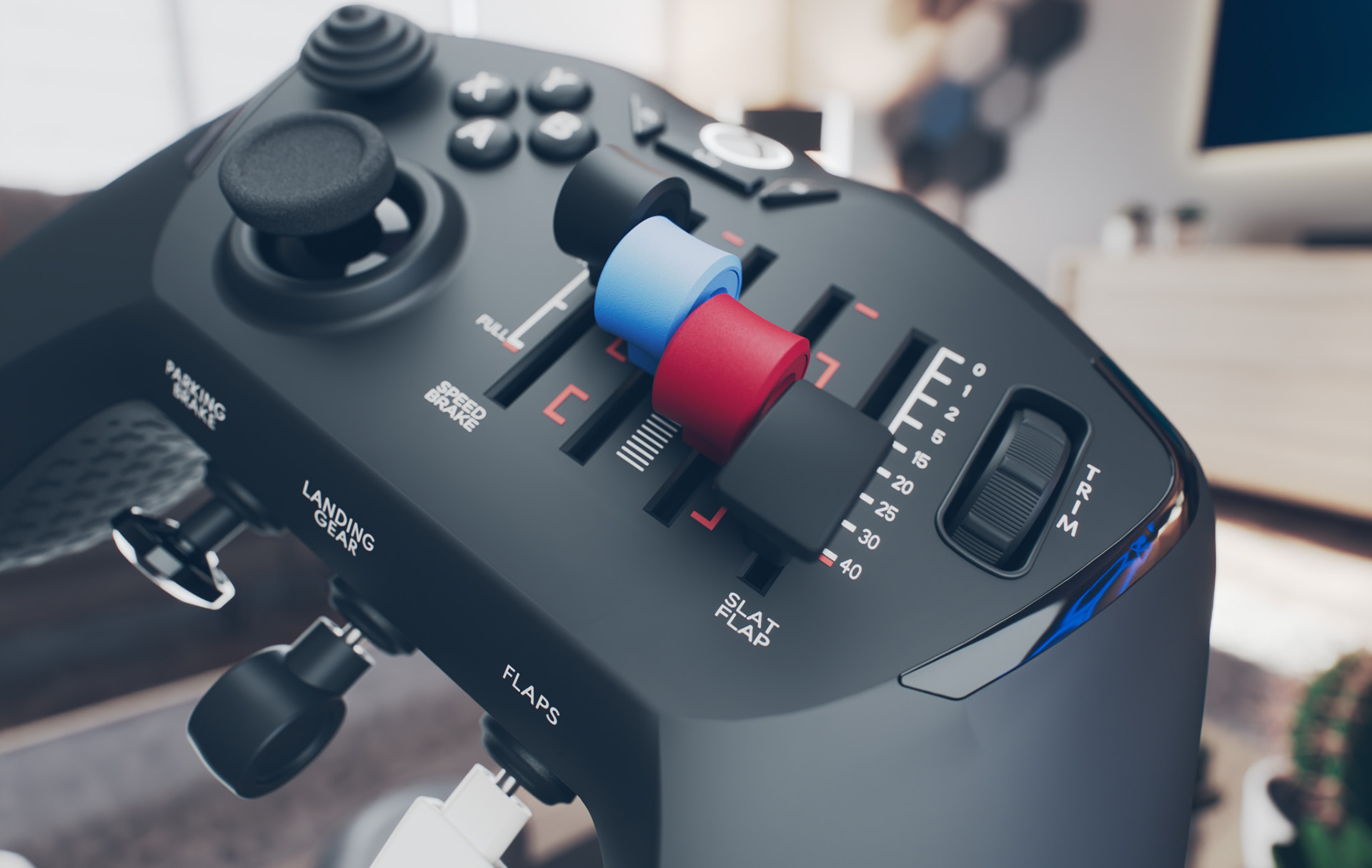
Flight sims’ hardware requirements have long been a barrier to entry, but a new controller by Honeycomb looks to alleviate that logistical problem.
The issue isn’t that existing hardware is hard to use or inadequate to the task, but that so much of it is big, expensive, and hungry for your space. The dream of a realistic 737 cockpit experience is out of most gamers’ reach. A proper setup — almost a requirement to make games like DCS World or Microsoft Flight Sim remotely accessible — can mean a yoke, throttle quadrant, rudder pedals, button panels, clamps, and cables, not to mention a monitor or three. More serious gamers might want a piece of VR gear like the Pimax Crystal Light. It’s expensive, and for many newcomers, unrealistic.
Honeycomb, a company already in the flight sim space with aforementioned yokes and pedals, thinks the solution is a specialized handheld controller: the Echo Aviation Controller XPC.
This will come as a particular relief to gamers looking to fly their Dreamliners on an Xbox. The Echo Aviation Controller XPC is not trying to replace a full cockpit rig for the most committed flight sim crowd. Instead, offers a controller-shaped flight system that doesn’t cost the earth.
That, in turn, allows users a low-commitment way to see if the flight sim genre really is for them. It’s all too easy to be put off seeing your Cessna lurching around as you try to control it with your mouse and keyboard. The Echo will go a long way to eradicating that experience for good.
The Echo Aviation Controller XPC is designed for Xbox and PC, and is expected to begin shipping later in 2026. At a glance, it does look more like a specialist gamepad than a traditional flight controller. Underneath that smaller shape, though, Honeycomb has packed in controls for pitch, roll, yaw, throttle, trim, landing gear, flaps, parking brake, and other aircraft functions. When I was setting up my flight sim gear, I found I needed to buy an extra, powered USB hub just to plug it all in. This attaches with just one wire.
Microsoft May Be the Immediate Beneficiary
For Xbox users curious about Microsoft Flight Simulator, the availability of a controller in this small form factor make the difference between getting involved or not.
The sim itself has already done much of the hard work of making an enthusiast-grade genre feel at home on console. It looks extraordinary, it runs on a living-room box, and it can be played from the sofa. The sticking point has always been control. A standard Xbox controller works, but flying by hammering the X button does not offer a true-to-life experience. It’s a huge compromise.
The Echo XPC tries to solve all of this without asking you to leave your sofa. It includes a precision analog stick for elevator and aileron control, rear rudder paddles, four independently assignable throttle levers, an integrated trim wheel, and physical switches for common cockpit actions. That means you can manage the core rhythm of flight without constantly reaching for a keyboard or needing to memorize button combinations like you’re learning to play chords on guitar.
The sensor technology is part of the pitch, too. Honeycomb is using TMR sensors for the analog stick and Hall Effect sensors for the rudder controls. Both are contactless sensing technologies, which means they are designed to reduce wear compared with traditional potentiometer-based inputs. This means the controller should be built for more precise, longer-lasting control, with less chance of the drift problems that have haunted plenty of modern gamepads, and be an absolute killer as you try to trim your flaps.
Flight simulation has become so much more accessible on the software side, but the hardware side has often lagged behind. Microsoft Flight Simulator and similar sims can now deliver huge worlds, live weather, detailed aircraft, and console-friendly interfaces, yet the physical control problem remains awkward. The genre still carries the assumption that the “proper” way to play involves a desk and a pile of gear.
Compact Solution More Appropriate to Mixed-Use Environments
A compact controller like the Echo XPC challenges all of this. It makes flight sim hardware more living-room-friendly, and less intimidating without abandoning precision entirely. That could make the genre easier to approach for players who are curious about simulation but not ready to invest in a full yoke-and-pedals setup.
Console flight sim players have often been treated as a secondary audience when it comes to specialist peripherals. PC simmers get the most choice, the deepest configuration options, and the broadest hardware support. A dedicated Xbox-compatible device makes the platform feel less like a toy version and more like a legitimate place to build your upcoming, expensive sim habit.
Of course, this will not satisfy everyone. A handheld flight controller cannot fully reproduce the feel of a yoke, separate throttle quadrant, and proper rudder pedals. Players flying complex aircraft for long sessions may still prefer a dedicated desk setup, and plenty of simmers will happily keep their cockpit rigs exactly as they are. The point is not that the Echo XPC makes all that obsolete, it isn’t aimed at those players. It’s aimed at those who want to try.
Honeycomb’s controller takes the core idea of a flight sim setup and compresses it into something more approachable, portable, and sofa-friendly. If it works as intended, it could make flight simulation feel less like a hobby that requires a dedicated corner of the house and more like something players can properly enjoy from the same place they already play everything else.
The XPC is due to start shipping later this year.
Also in Gaming News
PlayStation’s Disc Exit Pushes Game Ownership Further Into the Cloud
Sony’s decision to end physical disc production for new PlayStation games from January 2028 is not just another sign that boxed games are old news. It is a major platform shift that changes what “buying a game” is likely to mean for millions of players for the rest of eternity.
From January 2028, new PlayStation games will be released through PlayStation Store and retailers in digital formats only. Games already released on disc, or due to arrive on disc before that date, will not be affected. That softens the immediate blow, but the direction is clear. For future PlayStation releases, the disc is being removed from the equation, and the days of a beautiful games collection are numbered.
The technology behind that shift has been building for years. Consoles now ship with large internal SSDs, storefronts are tightly integrated into the operating system, and games often depend on patches, accounts, entitlement checks, cloud saves, online modes, and downloadable content. A disc may still feel like the more permanent option, but for many modern games, it is already only one part of the access chain.
Sony is following the data. Digital downloads now make up the overwhelming majority of PlayStation full-game sales, and the PS5 generation has already normalized disc-free hardware. The original PS5 launched with a digital-only model, while later revisions made the disc drive an optional attachment rather than something built into every console. Ending new disc production in 2028 is not a sudden turn. It is the next step in a long transition.
For players, the benefits are familiar. Digital games are convenient, instantly available, tied to an account, and do not require shelf space or a disc drive. For Sony, they reduce manufacturing and distribution costs, simplify retail logistics, and keep more purchasing activity inside the PlayStation ecosystem.
The concerns are just as familiar. Digital games cannot be traded, lent, sold second-hand, or preserved in quite the same way. Access depends on accounts, licenses, storefronts, storage, and long-term platform support. If a game is delisted, a store closes, or rights change, the question becomes less “do I still own the disc?” and more “will the platform continue to let me download and play this?” Games have music license requirements that run out – the likes of EA FC or many racing games feature tracks by “real” artists who have lent their work for a limited period of time. On a disc-based game, that was not an issue. It is now.
It is not only about collectors losing boxes. It is about the infrastructure of ownership moving from plastic media to servers, accounts, storage, and licenses. It also puts more pressure on console storage. A digital-only future means every new game has to live on the internal drive, an expansion card, or external storage, and modern game file sizes are not getting smaller, and storage is getting phenomenally expensive to purchase.
Sony’s decision may also say something about the next PlayStation generation. If new games stop shipping on disc in 2028, it becomes harder to imagine future hardware being designed around physical media in the same way.
The end of new PlayStation discs could make buying games easier in the short term, but it also makes trust in digital libraries, refunds, preservation, and platform continuity more important than ever.
Steam Machine Still Has to Prove the Living-Room PC Makes Sense
Valve’s new Steam Machine has picked up a very mixed early verdict from former PlayStation executive Shuhei Yoshida, and his reaction gets to the heart of the living-room PC problem.
After spending a few hours with the device, Yoshida described its 3D performance as “meh” and questioned why the system was recommending 1080p as the default, joking that it felt like going back to the PS4 era. He also said some games took a long time to boot, and that the Steam Controller’s touchpad was very sensitive and hard to use. That is not the sort of first impression Valve would ideally want from someone who knows a thing or two about console hardware.
His comments were not all negative. Yoshida praised the Steam Machine’s small form factor, quietness, and easy-to-use system interface. He also called the ability to turn the machine on with the Steam Controller a “killer feature,” which may sound basic until you remember what Valve is actually trying to do here. A gaming PC connected to a TV can already run Steam. What it usually cannot do is behave like a console without fiddling.
That is the technical challenge. The Steam Machine is not just competing on frame rates or game libraries, rather it is trying to make PC gaming feel natural in the living room, with quick booting, controller-first navigation, easy suspend and resume, predictable performance, and minimal friction. Those are things consoles have spent decades refining.
Valve does have an advantage this time that it did not have during the original Steam Machine push. SteamOS, Proton, controller support, and living-room UI work have all improved dramatically because of the Steam Deck. Valve engineers have said much of the work needed for the Steam Machine was already done through Steam Deck development, with the main new challenges involving discrete GPU and VRAM management. That gives the new machine a stronger foundation than the fragmented Steam Machines of 2015.
The problem is expectation. Console buyers expect a box under the TV to be simple, quiet, reliable, and good value. PC players expect flexibility, upgrade paths, and performance. A Steam Machine has to satisfy both groups without fully belonging to either. If it feels underpowered for the hefty price, console players may not see the point. If it feels too closed or too modest, PC players may prefer a normal gaming rig.
The idea of a living-room Steam box remains attractive, especially for players with large Steam libraries. But the hardware has to make that library feel effortless on a TV. If players still notice slow boots, odd defaults, control quirks, or performance compromises, the promise becomes harder to sell.
For Valve, the Steam Machine is not only a device. It is another attempt to make PC gaming behave like a console without losing what makes PC gaming appealing. That is a difficult balance, made more so by the current price of components, and early hands-on reactions suggest the concept is still easier to admire than to recommend.
Portal 2’s Steam Frame Rating Shows Valve Building Another Compatibility Layer
Sticking with Valve, Portal 2 receiving a Steam Frame compatibility rating is a small detail but one that points to the fact that Valve may be getting ready to announce a release date for the last of its current hardware push.
The game has been rated “Playable” for Steam Frame, Valve’s upcoming standalone VR headset. That means Portal 2 should run on the device, but it does not meet every condition required for a full Verified rating. In this case, the issue appears to be resolution support. Portal 2 works with the headset’s default controller configuration, shows the correct controller icons, performs acceptably with default graphics settings, and has readable interface text, but it does not support Steam Frame’s native resolution.
Valve’s headset is expected to offer a major display jump over the older Valve Index, moving from 1,440 × 1,600 per eye on Index to 2,160 × 2,160 per eye on Steam Frame. A game can therefore work well enough to play while still falling short of the ideal presentation expected from the new hardware.
The bigger point is the rating system itself. Steam Frame compatibility appears to follow the same broad idea as Steam Deck and Steam Machine verification: Unsupported, Playable, or Verified. Unsupported means a game is effectively not suitable for the device. Playable means it works, but with caveats. Verified is Valve’s strongest signal that a game behaves properly out of the box.
That might not sound glamorous, but it is one of the most important pieces of infrastructure Valve has built around its hardware. PC gaming’s biggest strength is also its biggest problem: variety. Different hardware, operating systems, controllers, anti-cheat systems, screen resolutions, and performance profiles all make compatibility difficult to explain. A simple rating badge turns some of that complexity into information players can understand before they buy or install. Remember, if you are coming over from a console into PC gaming, it is likely you have never had to fend for yourself in this way before.
With Steam Deck, that system became part of why the handheld worked so well. Players did not need to guess whether a game could be played on Linux-based handheld hardware. Steam told them. If Steam Frame is going to succeed as a standalone headset, it needs the same kind of trust. VR already has extra friction compared with ordinary PC gaming, and standalone VR adds another layer because games may behave differently when running directly on the device rather than streamed from or connected to a full PC.
Portal 2 is an interesting test case because it is such a famous Valve game, a beloved PC classic, and a title often associated with VR experimentation by the community. If even Portal 2 can land at Playable rather than Verified, it shows Valve is not simply rubber-stamping its own catalog. The company is applying a hardware-specific checklist, even where the result may be slightly awkward.