





 When you buy through affiliate links in our content, we may earn a commission at no extra cost to you. Learn
What is NLP (Natural Language Processing)?
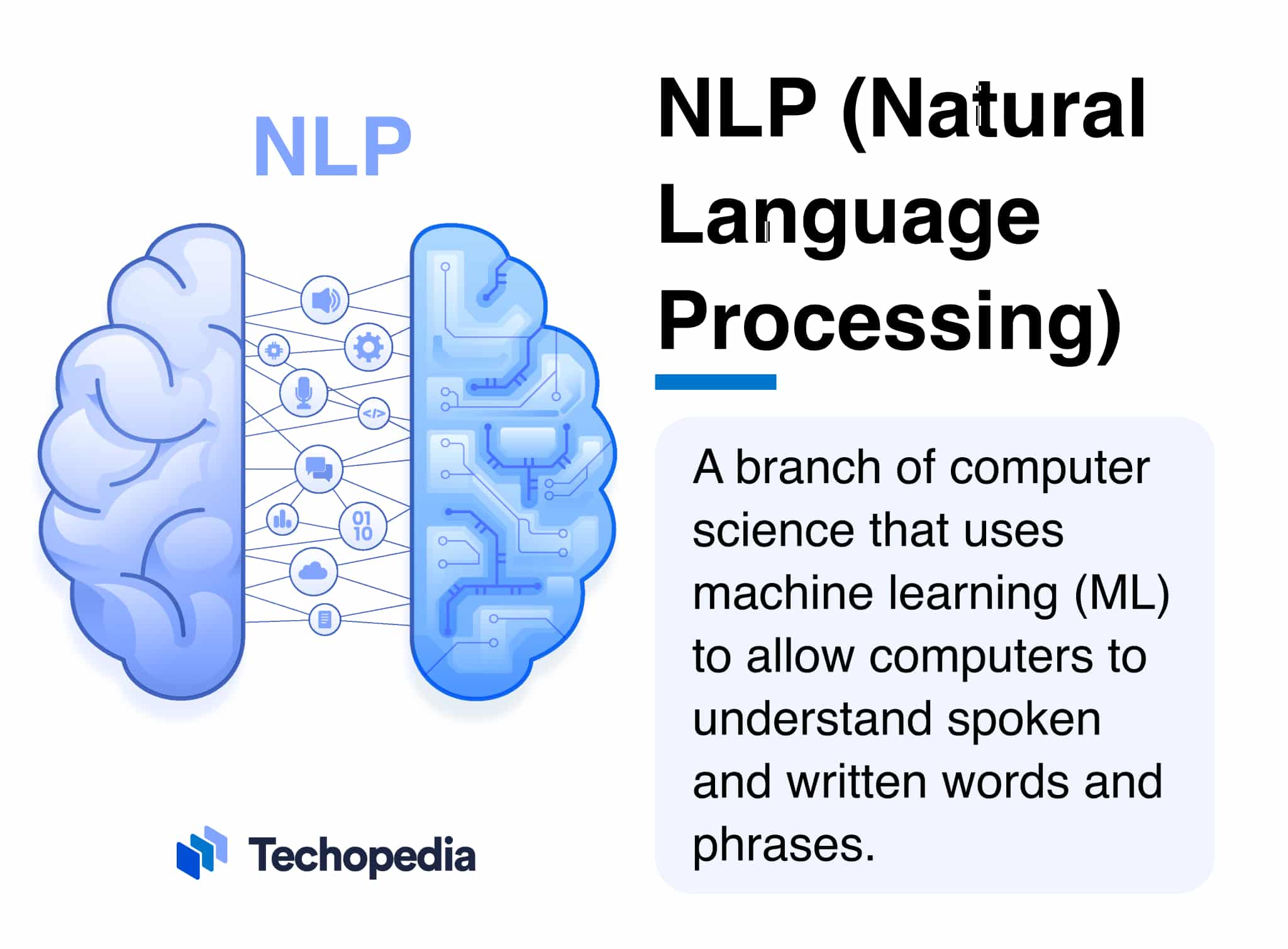
Natural language processing (NLP) is a branch of computer science that uses machine learning (ML) to allow computers to understand spoken and written words and phrases. Using NLP techniques, laptops and smartphones can recognize, understand, and reply to text and speech based on a mix of linguistics and statistical modeling.
NLP uses one of three methods: rule-based, statistical, or deep learning to understand the meaning of vocal and text inputs. It helps power customer service chatbots, digital voice assistants like Alexa and Siri, and machine translation. In business software, NLP helps enterprise solutions boost productivity and simplify process automation.
Key Takeaways
- Natural language processing lets computers understand and communicate with humans using spoken and written language.
- There are three different approaches to NLP: rules-based, statistical, and deep learning.
- Research into NLP helped pave the way for generative AI, from the way large language models (LLMs) engage in conversations to the ability of image generators to comprehend requests.
- NLP is especially helpful for automating repetitive tasks like document handling and data entry.
- NLP already powers search engines, customer service chatbots, and digital assistants like Apple’s Siri.
History of Natural Language Processing
How NLP Works
Natural language processing happens in three phases: pre-processing, training, and deployment.
Pre-processing
Training
Happens when data scientists apply the pre-processed text data and use it to perform specific operations. Training NLP machine learning algorithms to identify patterns in language and generate accurate responses requires large data sets.
Deployment
It’s the final step. An NLP machine learning algorithm receives an input and predicts an output for the specific use case it’s designed for. Users can run the NLP application on new data and generate an accurate output.
Approaches to NLP
There are three main types of NLP model:
This system uses carefully designed rules about the use of language in human conversations and written correspondence.
These methods are mainly for machine learning models, which learn to execute tasks based on training data. They can fine-tune their methods and outputs as more training data is ingested.
This sophisticated type of machine learning model is used in generative AI and has rapidly become the leading form of NLP. By using large volumes of raw, unstructured data like voice and text, NLP based on deep learning can become progressively more accurate.
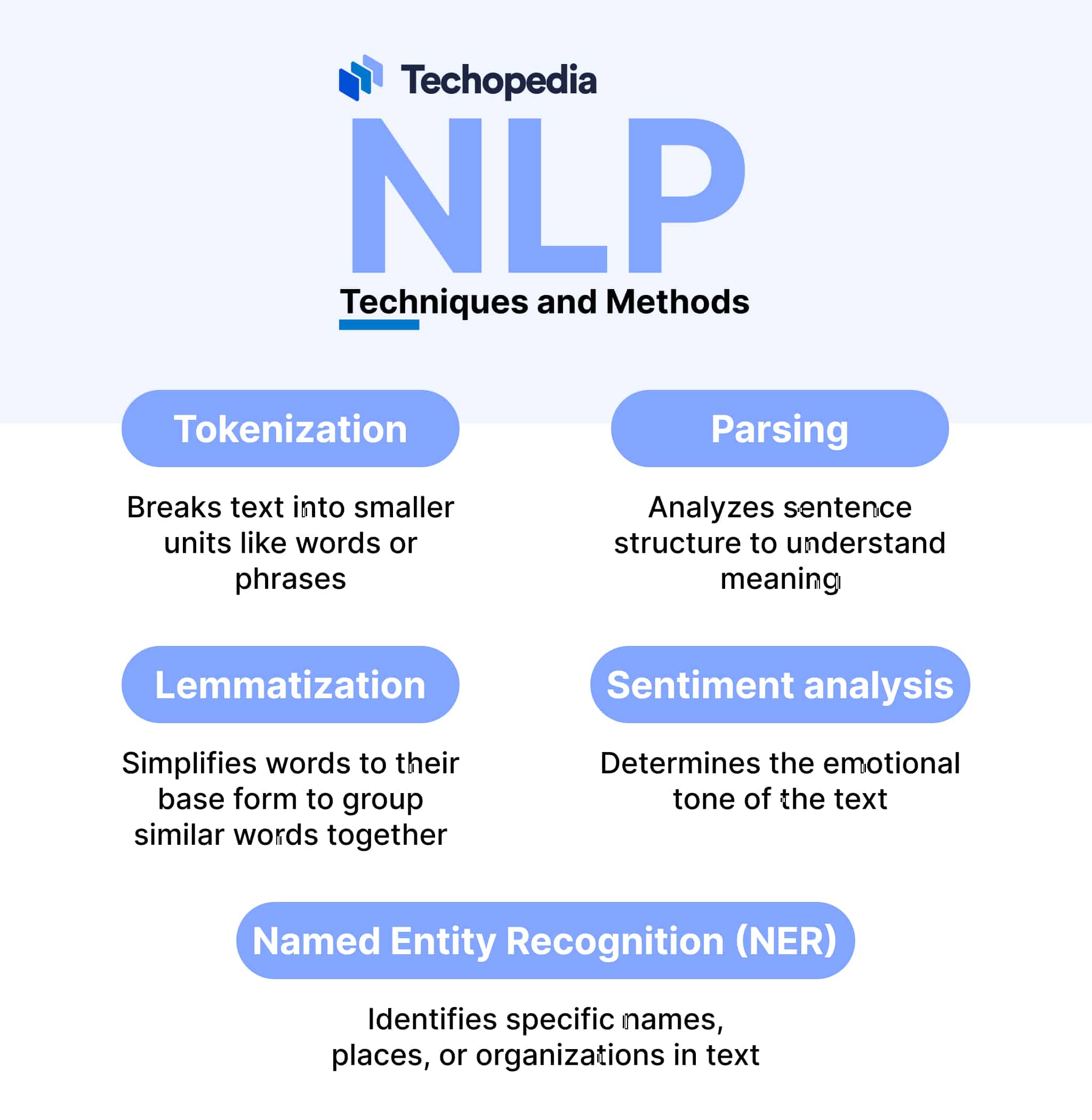
NLP Techniques and Methods
NLP Use Cases
NLP is used to automate repetitive tasks and labor-intensive business processes.
These include:
- Analyzing, processing, and archiving large files for storage.
- Generating sophisticated AI text outputs from user voice and text prompts.
- Looking for patterns in customer feedback and communications.
- Automating chatbots for faster customer service.
- Answering basic queries about a product or service.
Natural Language Processing Benefits
NLP improves big data analytics by making the extraction and processing of unstructured data more reliable. This can include news and feature articles, social media content, or online reviews.
NLP tools can identify trends and patterns, even identifying sentiment that would be hard to pick out manually from a large data set. Sentiment analysis by NLP allows subjective qualities like emotional tones and attitudes to be discerned within the text.
One practical application of this capability is the routing of communications to the department best equipped to handle them.
NLP makes search more effective by enabling search algorithms to understand the intent behind keywords, providing more contextually relevant results.
Instead of relying completely on word-for-word keyword matching, NLP-powered search engines can understand the meaning of disjointed words and phrases, making it easier to return relevant information even when search terms are vague or confusing.
This improves the end-user experience, from website search engine queries to enterprise document management systems.
The role of NLP in generative AI (GenAI) and large language models (LLMs) is to help them generate human-like text in numerous applications. Pre-trained genAI tools like GPT-4 can generate complete articles, detailed reports, advertising copy, and product descriptions and even engage in literary writing.
NLP can also automate complex tasks like creating legal documents, writing emails, or doing research for an article or report.
By finding the patterns that indicate context, tone, and style, NLP helps keep AI-generated content coherent and in sync with the original user prompt, saving time and effort on content creation while protecting relevance and quality.
NLP Challenges
For NLP applications and overall capabilities to improve, experts have noted the following challenges:
Most software development happens in the Anglosphere – particularly the United States. If developers are hoping to reach an international audience, support needs to be provided for multiple languages.
Sometimes there won’t be a clear and concise meaning in a literary analysis of something a person has said. An NLP tool must be able to look for context, understand phrasing, and ask users for more clarity.
Some NLP tools exhibit behaviors that reflect the biases of their programmers, or biases that exist in their training data sets. An NLP could, for example, reinforce certain prejudices or give preferential treatment to certain types of users over others.
The Bottom Line
Why is natural language processing important? Modern organizations are awash with unstructured data, which by definition means voice and text data from images, emails, SMS messages, social media accounts, audio, and video.
NLP-powered tools can process data in these formats, analyze the content for meaning and emotional tone, and respond to human prompts almost immediately.
NLP is critical for analyzing large volumes of text and speech data to find patterns. It can identify and categorize differences in slang and dialect while also grammatical irregularities in normal human interactions.