


 When you buy through affiliate links in our content, we may earn a commission at no extra cost to you. Learn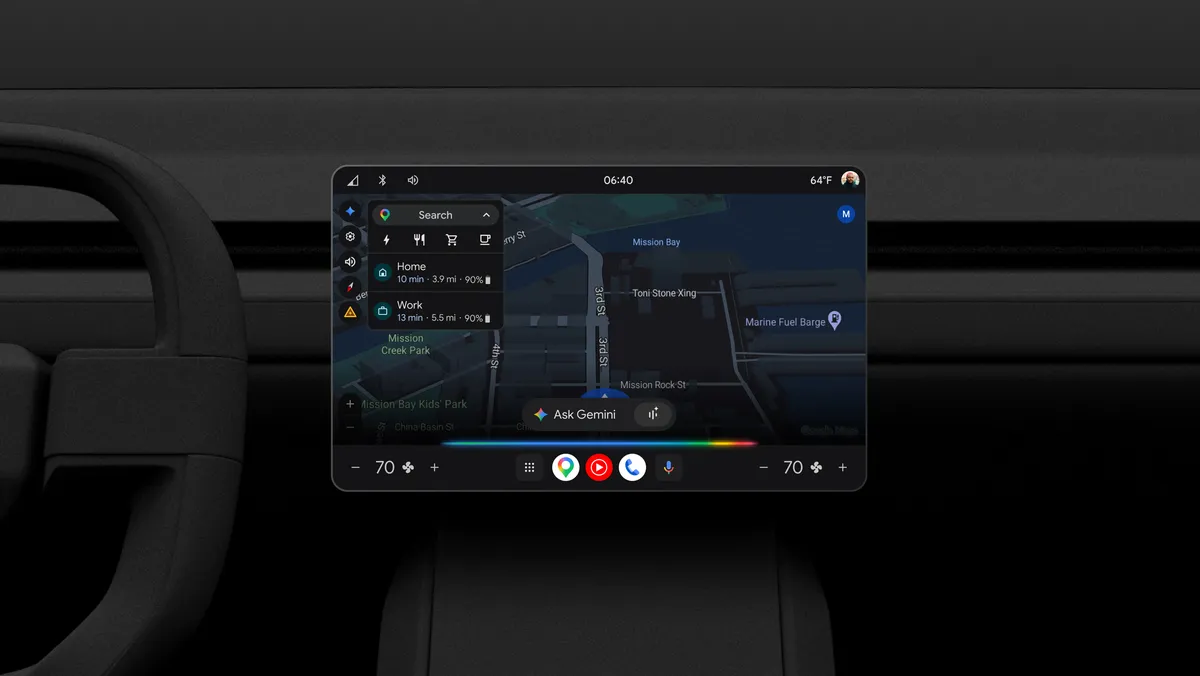
Drivers of cars with built-in Google functionality will soon see Gemini AI replace the older Google Assistant. English-language users in the United States will be the first to get the upgrade, announced April 30. Cars currently running on Google Assistant will receive Gemini AI with their next software update.
So long as you’re eligible and signed in to your Google Account, you’ll be prompted to make the switch once it’s available.
A couple of days before Google’s announcement, GM said it would bring Gemini to its vehicles, of which 4 million in the U.S. are eligible for the update. The automaker said the software update will roll out over several months to eligible 2022 and newer Cadillac, Chevrolet, Buick, and GMC vehicles.
GM touted Gemini as being more intuitive for drivers than Google Assistant.
Google describes the update in similar terms, saying that having the conversational Gemini-powered AI assistant in the dashboard will allow drivers to “speak naturally to get more things done with [their] favorite apps.”
Google Assistant relies on a fix set of voice commands. Drivers will be able to interact with Gemini through free-flowing conversations. They can ask the AI for help with directions, searching for restaurants, getting traffic information, replying to text messages, or controlling music.
They can even ask their car questions about itself.
According to Google, Gemini has access to the specific owner’s manual for each car and can field questions about model-specific features. The examples the company gave include things like how to get a vehicle ready for a car wash or how to adjust how high the trunk hatch lifts when opening. Owners of EVs will also be able to ask Gemni about their battery status, estimate how much charge will be left upon arrival, and find nearby charging stations.
That feature list is why the car may be one of the most revealing test cases for consumer AI. Google isn’t positioning this dashboard upgrade as a generic way for drivers to ask general questions. The company is selling it as a practical, hands-free layer for navigation, messaging, media, vehicle controls, and EV range management.
Gemini for Vehicles Will Be a Proving Ground for ‘Everyday AI’
Gemini isn’t the first generative AI assistant to make it into a car’s dashboard. Mercedes-Benz added ChatGPT to its MBUX Voice Assistant in 2023 as an optional beta for more than 900,000 U.S. vehicles equipped with the MBUX infotainment system.
What makes the Gemini rollout worth watching is that it’s happening on a much larger scale than the Mercedes-Benz beta and through Google’s own in-car platform.
GM has already said it’ll bring Gemini to millions of its vehicles. That alone gives Google a large real-world test case for whether drivers want conversational AI in their cars.
In many ways, the car is one of the places where having a voice assistant has always made the most practical sense. We need to keep our eyes on the road when we’re driving, and having a voice assistant to chat with lets us get quick answers without having to tap through menus on our car’s infotainment system, or, even worse, pick up our phones.
The Gemini upgrade gives Google a chance to make the in-car assistant feel more like a natural interface. While you’re driving, you could ask it to find a highly rated sit-down restaurant, then follow up with questions about parking or vegetarian options, and keep the conversation going without having to start over.
That kind of back-and-forth is especially important in a car, where the best interface is often the one that lets users keep their heads up and hands on the wheel.
With Gemini being added to vehicles with Google built in, the company now has its AI assistant inside many of the products people use every day, including phones, TVs, smart home devices, and now cars.
The car dashboard is a valuable testing ground in the AI race because it brings together so many of our tech habits at once: navigation, messaging, media, local search, and vehicle controls.
If you’re not in the U.S., you probably won’t have to wait too long for Gemini if you have an eligible vehicle. Google says its AI assistant will be coming to more countries and languages soon, with future support for safe access to apps like Gmail, Calendar, and Google Home.
Also in Consumer Tech News
Google TV Adds More Gemini Features and YouTube Shorts
On April 29, Google announced that it is bringing new features to Google TV, including AI image and video creation tools through Gemini. The update also adds voice search for Google Photos, Google Photos Remix, dynamic photo slideshows, and a new “Short videos for you” row that will start with YouTube Shorts.
Nano Banana and Veo will be available first on Gemini-enabled TCL Google TVs in the U.S., while a new “Short videos for you” row featuring YouTube Shorts will roll out to U.S. Google TV devices this summer.
The update gives Google another big-screen surface for Gemini while also bringing short-form video more directly into the living room.
Motorola Adds Three New Razr Flip Phones
Motorola announced on April 29 that it’s adding three new foldable flip devices to its smartphone lineup: the Razr Ultra, Razr+, and Razr.
The company says the Razr Ultra is the most powerful Razr to date and ships with a triple 50-megapixel camera system, AI-powered features, a large battery, fast charging, and a more capable external display.
The Razr+ and standard Razr also come with improved displays, camera features, and battery life. The new phones keep Motorola in the foldable phone race as other companies try to make their premium devices feel more useful by adding AI features, camera upgrades, and larger cover screens.
Apple Reports Strong Earnings Despite Mac Supply Constraints
During its earnings call on April 30, Apple reported fiscal second-quarter revenue of $111.2 billion, up 17% year over year, with diluted earnings per share up 22%. The company also said Services revenue hit an all-time high.
While its earnings were strong, the availability of Macs is something worth watching. Apple CEO Tim Cook said Apple expects most of its June-quarter supply constraints to affect several Mac models, including the Mac mini, Mac Studio, and MacBook Neo.
He said demand for the Mac mini and Mac Studio has been higher than Apple expected, partly because both products are being recognized as platforms for AI and agentic tools.
Cook added that the Mac mini and Mac Studio could take several months to reach supply-demand balance. So if you were planning to buy one of these devices, you might have to wait a while.
OpenAI Adds Advanced Account Security for ChatGPT Users
OpenAI is adding Advanced Account Security as an opt-in setting for users who want an extra layer of protection for their ChatGPT accounts.
The company announced the feature on April 30, saying it’s designed for people who are at risk of digital attacks as well as users who want the strongest account protections available. The protections also apply to Codex.
The setting strengthens sign-in protections, tightens account recovery, shortens active sessions, adds login notifications and clearer session management, and turns off weaker sign-in paths like password sign-in and email or SMS codes.
OpenAI says conversations from enrolled accounts are excluded from model training by default.
ChatGPT Images 2.0 Gains Early Traction in India
After introducing ChatGPT Images 2.0 on April 21 and making the new image-generation model available across all of the platform’s plans, India is where the tool has seen the most traction.
That’s according to reporting from TechCrunch, which cited OpenAI and said Sensor Tower estimated that ChatGPT was downloaded about 5 million times in India during launch week, compared with about 2 million times in the U.S.
However, the overall global lift appears more limited so far, with Sensor Tower data showing app downloads up 11% week over week but daily active users and sessions up only about 1%.
TechCrunch says that early users in India are mostly using the tool for personal visuals, including stylized portraits, avatars, photo restoration, and fashion moodboards.