

 When you buy through affiliate links in our content, we may earn a commission at no extra cost to you. Learn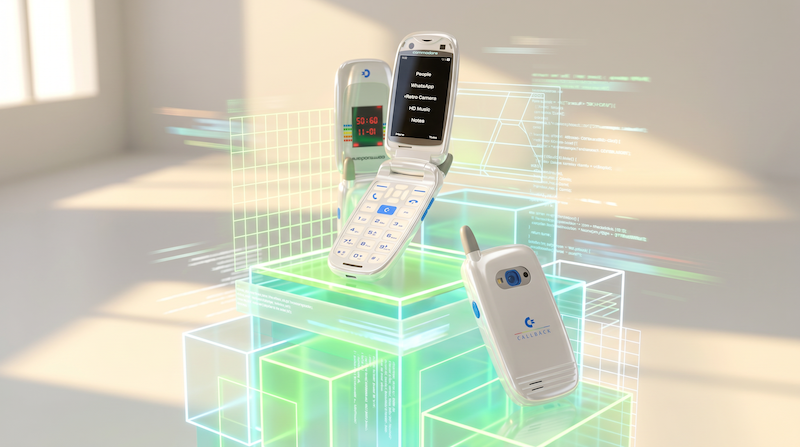
Commodore is back with a flip phone for people who want their phones to do less.
The Callback 8020 is what the company calls a new “not dumb dumbphone” that blocks time sucks like social media and web browsers while keeping the apps people need most on the device.
That means buyers won’t have to give up WhatsApp, Google Maps, Spotify, rideshare apps, podcasts, QR codes, calendars, 2FA apps, and SMS.
If the Commodore name rings a bell, it may be because of the Commodore 64, one of the best-known home computers of the 1980s.
As the brand positions itself for a comeback, it’s betting that consumers don’t necessarily want to do away with all the trappings of their smartphones. Instead, the company believes many of us want a modern phone minus the modern distractions.
In that way, Callback is more than just another retro device. It comes at a time when many are questioning the utility of smartphones and the consequences of an always-connected life.
Because of work, family, and social obligations, many of us feel trapped between two bad options: a smartphone that tempts us to use it whenever we have any idle time, and a dumbphone that removes so many useful tools that it’s barely functional.
Commodore is arguing that the better option might just be selective connectivity. The Callback keeps the smartphone features many of us have come to rely on while removing the feeds, work apps, and open-ended internet access that make modern smartphones feel impossible to put down.
Commodore Brings Back the Flip Phone for the Doomscrolling Era
Commodore says the Callback is a device that sits in that space between smartphones that are “too smart” and dumbphones that are “too dumb.” As the company puts it, their phone “does everything you want, nothing you don’t.”
If you think you want to pick up one of these phones, keep in mind that its main feature is restriction. Since the Callback blocks social media and browsers at the system level, if at some point you decide you want to return to your doomscrolling habit, you won’t be able to do so on this phone.
Its blocklist is pretty extensive and includes Facebook, Instagram, Snapchat, Threads, TikTok, X, YouTube, Reddit, Kick, Twitch, Discord, and Roblox. The Callback also blocks all browsers, including sideloaded browser APKs. While users can sideload apps outside the blocked categories, Commodore says the browser and social media blocks cannot be turned off.
So, before paying the almost $500 price tag, buyers will want to be sure they’re fully committed to a minimalist phone life with very few escape hatches.
Making it hard to get around the blocks on social media and browsers is part of the phone’s logic, Commodore says. After all, blocking TikTok, Instagram, and other apps wouldn’t do much good if users could open those same feeds using Chrome or Firefox.
Commodore says it blocks browsers because “the browser is the back door,” allowing social feeds, video sites, news spirals, and endless searches to remain available even when apps are restricted.
When you buy Callback, you’re buying a hardware boundary. The flip closure, T9-style texting, tactile buttons, screen-free dome LED notifications, and lack of open web access all add friction to everyday use.
Commodore Callback Keeps Essential Apps While Blocking Social Media
Most of us, at one time or another, have promised ourselves that we’re going to cut back on our phone use. That’s what makes minimalist phones like the Callback an attractive option, especially if you’ve made a habit of doomscrolling late into the night.
The problem for many of us is that we rely on our smartphones for so much of our lives. Whether that means checking Slack to keep up with work or using an app to order food, those everyday tasks are what make smartphones so hard to quit.
Commodore seems to understand this dilemma. The Callback runs Sailfish OS, developed by Jolla, and Commodore says it can run most Android apps through a sandboxed Android AppSupport environment.
However, it doesn’t come with the Google Play Store or Google Play Services, so some apps may not work as they would on a standard Android device.
WhatsApp comes preinstalled, and Commodore says the phone supports Signal, Telegram, WeChat, 2FA apps, Okta Verify, and even iMessage access through supported third-party bridge solutions, with caveats around Apple’s control over that access.
But if you want the option of working on your phone, the Callback probably isn’t the device for you. The company says the Commostore doesn’t offer email or work apps. Instead, the phone is for people who want to leave behind email, Slack, Teams, and all the digital demands that let work slip into personal time after hours.
The company may be onto something with its approach to removing some of the most distracting parts of smartphones.
A 2025 randomized controlled trial published in PNAS Nexus found that blocking mobile internet on smartphones for two weeks reduced smartphone use and improved subjective well-being, mental health, and sustained attention.
During the study, participants could still use their phones to make calls and text, and they could use other devices to access the internet; the intervention targeted mobile internet access, not communication itself.
That’s in line with what Callback wants to do. The phone isn’t asking people to give up all things digital. It’s just trying to remove the always-on internet layer that has turned smartphones into an all-day distraction machine for so many of us.
Digital Detox at a Premium Product Price
Looking at a photo of the Callback, it’s hard to understand why what looks like a basic flip phone costs several hundred dollars. And that may be one of the phone’s biggest challenges.
Commodore lists the Callback 8020 at $499.99, down from $549.99, excluding tax, with shipping expected to start this winter.
If you can buy a decent mid-range Android device with all the bells and whistles for around the same price or less, buying a pared-back phone can feel counterintuitive. That’s especially true for those who might consider it a second phone rather than a full replacement.
The company is clearly trying to avoid having the Callback categorized as a backup phone.
It’s marketing it as a smartphone replacement, with a 48-megapixel Sony rear camera, front-facing autofocus camera, HD and lossless audio support, FM radio, worldwide network support, Wi-Fi, hotspot support, a swappable battery, and included IEM earphones.
However, the Callback and other phones in this genre show that if you want to commit to digital minimalism, you’ll need to be prepared to pay close to premium prices.
Of course, that doesn’t mean the phone won’t have a market. For those who want to place strong boundaries around their phone use, it could be a no-brainer. The same goes for parents who want to restrict their children’s use of social media apps, privacy-conscious users, and people who want a weekend or evening phone that leaves social media feeds behind.
Nobody’s betting on the Callback becoming a mainstream hit. Smartphone manufacturers have spent years competing to make the most powerful, most connected, and most personalized devices, but things are changing.
People are asking for something different, with a growing slice of the market wanting devices that help them disconnect without disappearing completely.
The next phase of digital detox may come from products that make online life smaller, slower, and more intentional. Commodore is hoping to cash in on that shift with a phone for people who still need some of the modern world in their pocket, just not the entire internet.