

 When you buy through affiliate links in our content, we may earn a commission at no extra cost to you. Learn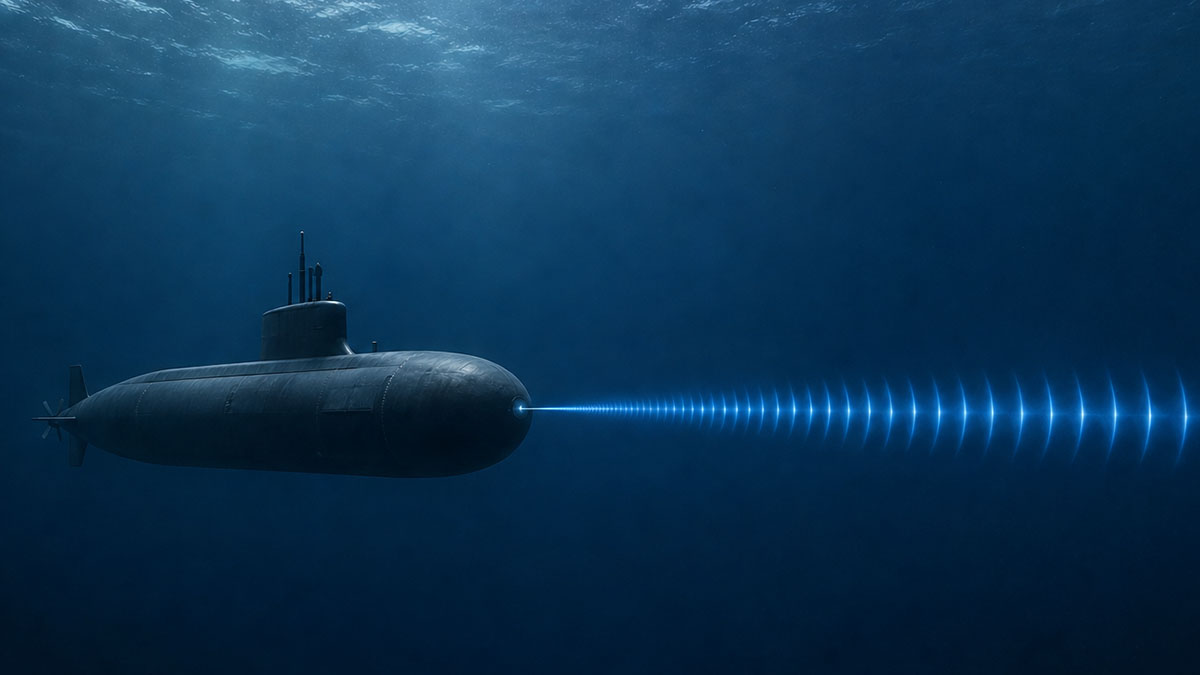
Researchers at Canada’s McGill University have announced a breakthrough in quantum-mechanical sound generation that they say could lead to the audio equivalent of lasers.
Laser beams maintain their focus because the light is coherent, meaning every photon has the same frequency. Any variation creates interference between the different components of a wave that causes them to spread out as they travel. Typical audio setups are the equivalent of a light bulb; even if playing a “perfect” sine wave, the sound from a speaker will be muddy enough that it will radiate out in all directions rather than traveling as a beam.
The McGill team built a device that traps electrons in a crystal so cold and thin — just a few atoms — that it constrains their motion to two dimensions. Forcing the electrons to move through this channel causes them to release bursts of energy as phonons, the acoustic equivalent of photons.
Of course, photons are “real” particles and phonons are quasiparticles. They represent the collective motion of multiple other particles, the same way that what we think of as a wave in the ocean is really the collective motion of a large number of water molecules. At the quantum scale, sound waves can behave like particles by the same token that photons (light particles) can behave like waves.
Suffice it to say that at the quantum scale, it becomes a difficult philosophical question to say whether something is a physically “real” object or a mathematical convenience. Perhaps the Universe is just made of math, and the distinction is a human construct.
Numerous Applications for a ‘Phonon Laser’
Back to the macro scale, though, this ability to generate discrete phonons at specific frequencies is analogous to the way we generate lasers by stimulating crystals to emit photons. That’s why the paper’s co-author, Dr. Michael Hilke, expects this to lead to laser-like technology with applications in communication and medicine.
“In a medium such as oceans, sound can travel, whereas light and electrical currents cannot. In the human body, sound waves can also be a useful tool.”
That is, he foresees technologies similar to sonar and ultrasound, but using coherent sound to be more precise and directional than current devices. A communications application could transmit sound directly through a medium like water, without much spread — the equivalent of talking through a wire between two tin cans, just without needing a wire.
The most difficult part might be deciding what to call it. “Laser” is an acronym standing for “light amplification by the stimulated emission of radiation,” but neither light nor radiation applies here. Terms like “audio laser” or “phonon laser” are oxymorons, yet “phaser” is already taken and means something different.
Something to ponder while we’re waiting for the future to arrive.
Also in Science News
Geographical Separation May Have Doomed Neanderthals
Around 40,000 years ago, European Neanderthals coexisted (and sometimes interbred) with early humans migrating out of Africa, but the Neanderthals disappeared soon thereafter. As is often the case when two similar but distinct species try to occupy the same niche, one survived and the other didn’t.
What isn’t totally clear is why humans came out on top. Ariane Burke from Université de Montréal theorizes that geographical barriers in the European geography may have played a role.
Head of the Hominin Dispersals Research Group, she cautions against simplistic, single-cause assumptions. Changing climate and competition from homo sapiens are often blamed. One factor her research points to is that the regions occupied by homo sapiens had better geographical connectivity, while the European Neanderthal population got split into distinct East and West groups.
That’s a fascinating theory, given the recent observation that the geographical splitting of the largest chimpanzee group in Africa was a precursor to mass violence between the apes. It’s another reminder that the ability to maintain social connections in large groups and across long distances is one of humanity’s most important technologies.
AI Accelerates the Search for Distant Planets
The number of known planets outside our Solar System is about to double, according to a prepublication draft of a paper from Cornell University. It was only 34 years ago that scientists confirmed identification of the first “exoplanet,” and to date they have found about 6,000. Another 10,000 candidates have emerged from the T16 Project’s analysis of nearly 84 million light curves captured from distant stars by the Transiting Exoplanet Survey Satellite (TESS).
This sort of work is progressing orders of magnitude more quickly than ever before, because it’s the sort of task that machine learning algorithms perform very well at.
Although telescopes have progressed to the point that we’ve managed to image the very largest and closest exoplanets, it remains the case that we discover new ones indirectly, by observing their effect on the light from the stars they orbit.
The simplest version of this is to watch for a star to dim slightly as a planet passes in front of it, but that only works for systems we can see edge-on. However, a more sophisticated method is to watch for fluctuations in the star’s apparent frequency, caused by the optical equivalent of the Doppler shift as it wobbles under the orbiting planet’s gravity.
Gulf of Alaska’s Mysterious ‘Golden Orb’ Explained
A years-long oceanographic mystery has been resolved, as researchers have finally identified a strange, gold-colored object that was hauled out of the Gulf of Alaska in 2023. Evocatively nicknamed the “Golden Orb,” the item turns out to have a somewhat disappointing explanation, unless you happen to be a scholar of cnidarian lifeforms.
Cnidocytes are stinging cells, and finding such cells in the object proved key to its ultimate identification. Such cells are characteristic of corals and anemones. After follow-up research by the appropriate specialists, the sample was confirmed to be the base of a giant deep-sea anemone called Relicanthus daphneae. Fortunately, there is no shortage of other weird mysteries in the sea.