

 When you buy through affiliate links in our content, we may earn a commission at no extra cost to you. Learn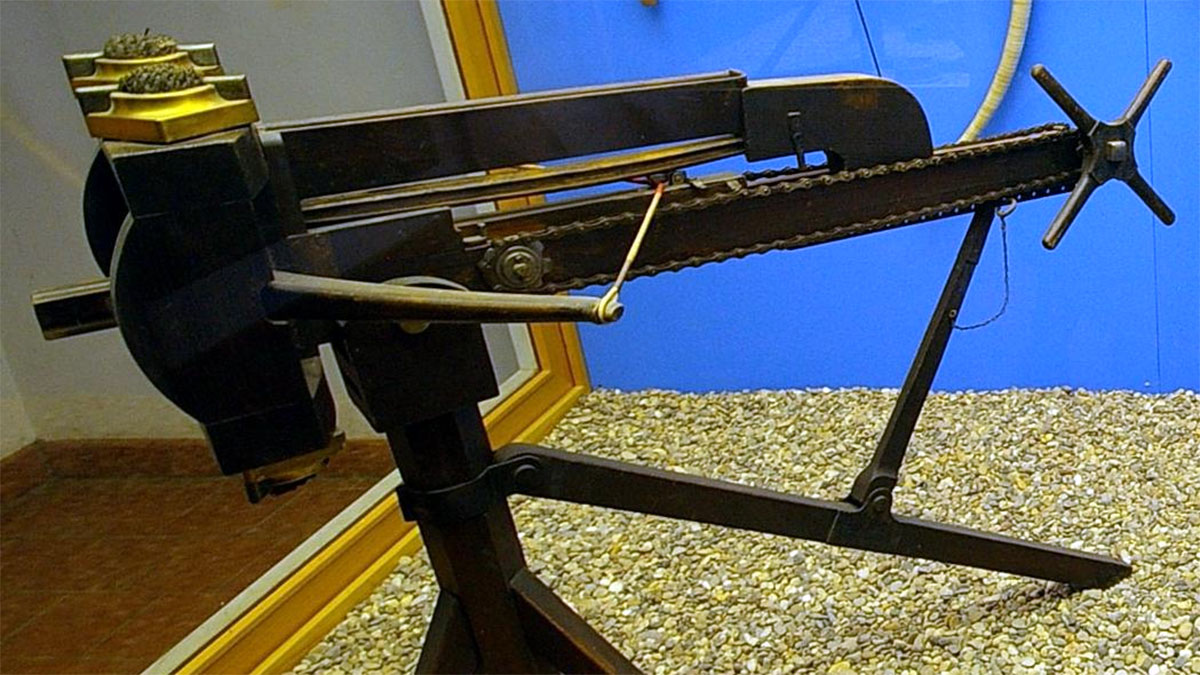
Forensics and archaeology have a lot in common, and some of the same technologies that help with crime scene investigation can be used to shed new light on how ancient civilizations conducted warfare.
Italian archaeologists recently found evidence for the use of polybolos during a 1st-century B.C. siege of Pompeii. These were a form of ballistae — giant crossbows, essentially — whose ability to fire repeated shots has led to them sometimes being described as “the first machine guns.”
That makes for a good headline, so this finding has been making its way around the pop-science blogs since the article’s publication at the end of February.
The walls of Pompeii were buried along with the rest of the city in volcanic ash just decades after the siege. The Italian team focused its attention on indications of battle damage that had been preserved on its outer surface. In particular, they were looking at sets of holes that stood out for being smaller, more square, and more tightly clustered than the others.
Using advanced 3D-scanning techniques, the researchers were able to reconstruct the geometry of the projectiles that would have made the holes, and match this to the heads of polybolos bolts found at other sites. The tight spacing of the holes also made sense, given the weapon’s rapid firing.
The team’s conclusions, however, suggest that they see this discovery not so much as groundbreaking in its own right as a proof-of-concept for bringing modern 3D techniques to bear on the topic of ancient warfare. In particular, they envision recreating ancient battles in a way that’s simultaneously compelling for a lay audience and grounded in verifiable facts.
Bringing the Past to Life Through 3D Simulation
Much of what’s known about polybolos comes from a 3rd-century B.C. description by Philo of Byzantium. However, modern recreations based on his text have demonstrated that such a machine does indeed function as advertised.
The paper’s authors now envision working backward from the damage at Pompeii to create a digital simulation and physical reconstruction of not just any polybolos, but one with the exact specifications of the ones used in that battle. They write:
“Rapid prototyping of CAD-based 3D components will allow real-time and low-cost experimentation with mechanical refinements, potentially overcoming the limitations of previous reconstructions and fostering a more substantial scholarly debate on the possible enhanced use of the polybolos—and, more broadly, of automatic artillery—in Roman warfare.”
The end goal, in part, seems to be to make ancient warfare more approachable for non-archaeologists. Through 3D scanning, modeling, printing, and simulation, archaeologists can move from the visible signs of damage from a battle to recreating the actual weapons involved and, from there, to a realistic virtual enactment of the battle itself.
Also in Science News
3D-Printed ‘WHASERs’ Track Icelandic Humpback Whales
Conservation ecologists studying humpback whales are also discovering the benefits of 3D printing. The rapid advancement of that field makes it easier than ever to overcome certain types of engineering challeges, such as customized protective housing for electronics.
Bambu Lab, one of the leading names in consumer-level 3D printers, is highlighting how its devices helped Whale Wise and Tandem Ventures perfect their “WHASERs” for tracking humpback whales.
WHASERs are drone-mounted devices that use a combination of camera footage and LiDAR (light detection and ranging) to differentiate and measure humpback whales from the air, even when they only surface for a few moments. The problem with the WHASERs was that they were fragile and cumbersome, but rapid iteration on the housing through 3D printing allowed them to become lighter, well-protected… and also cuter. The new equipment housing actually looks like a little whale stuck underneath the drone.
Voyager 1 Says Goodbye to Low-Energy Charged Particles Experiment
The first two Voyager probes have spent nearly half a century hurtling out of our of Solar System, but they’re starting to run out of power. NASA scientists have had to develop a prioritization plan and begin shutting down the least important systems in order to keep the probes running. Each bit of instrumentation consumes a little bit of electricity, and there needs to be enough left over for heating, because space is very, very cold.
The latest system to get the axe has been the low-energy charged particles experiment, or LECP. Voyager 2 had to make that change last March, and now Voyager 1 has followed suit. Both probes have now shut down more instrumentation than they still have running: only their magnetometers and plasma wave subsystems remain active. However, NASA engineers are working on an ambitious plan to switch over to lower-power systems, which could extend the probes’ lifespans.
Both probes generate power using heat from the radioactive decay of a block of plutonium on board. The isotope in question, plutonium-238, has a half-life of 87.7 years, meaning the probes lose about 0.8% of their fuel each year. NASA says that equates to an annual drop of 4 watts of power.
Measuring Gravitational Quantum Effects Could Be Within Reach
Reconciling quantum mechanics and general relativity is the “Holy Grail” of physics, but it’s extremely difficult for a number of reasons. Japanese physicists at Kyushu University think they see a way to overcome one of those problems.
This is the issue, in very simple terms: Quantum mechanical effects only become noticeable when you’re dealing with things that are very small. Gravity, however, is so weak that you can usually only measure its force when dealing with something very big. That makes it challenging to do experiments when trying to reconcile the relativistic effects of gravity with quantum mechanical predictions.
A team led by Professor Kazuhiro Yamamoto believes the solution is to turn one of quantum mechanics’ limitations into an asset. Heisenberg’s Uncertainty Principle states that the more precisely you measure an object’s momentum, the more uncertain its position becomes, and vice versa. They’ve developed a technique to measure a mirror’s momentum with extreme precision, thereby making its position highly uncertain.
In principle, that high position-uncertainty could allow researchers to check whether the phenomenon of quantum entanglement still occurs between the mirrors even when they’re cooled to a point that the only force between them is gravity. For now, however, it’s an experiment that remains in the conceptual stage.
Image Credit: SBA73 via Wikimedia Commons (license)